


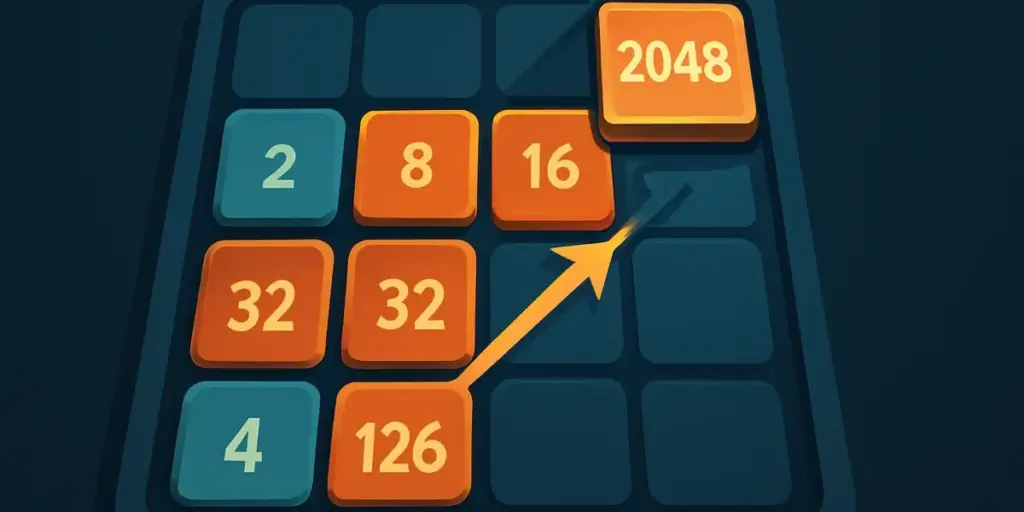
2048 Rogue strategy guide
2048 Rogue rewards patience more than frantic swiping. The basic goal is familiar: move matching number tiles together so they merge into a larger tile, then use the open spaces created by those combinations to keep the board alive. The difficult part is that every move changes the shape of the board, and a move that looks helpful now can leave your strongest tiles disconnected a few turns later.
This guide explains how to play 2048 Rogue with a controlled approach. You will learn how to choose an opening direction, organize the board, protect your largest tile, recognize safe and dangerous merges, and recover when the position starts to collapse. These ideas are useful for a first run, but they also give experienced players a more reliable way to improve their high score.
If you want to start practicing immediately, open 2048 Rogue and treat each run as a planning exercise rather than a race. The aim is not to make the most merges in the fewest seconds. It is to preserve options for the next several moves.
How to play 2048 Rogue
Most versions of this style of puzzle use four directional controls to slide every tile as far as possible in the chosen direction. Matching tiles combine when they meet, while different tiles remain separate. A new tile is then added after a move that changes the board. Because the available space becomes more limited over time, each swipe has two consequences: it changes your current arrangement and affects where future tiles can be placed.
Before moving, scan the entire board. Look for immediate pairs, nearly completed rows or columns, empty spaces, and the location of your strongest tile. Then ask a simple question: which direction improves the board without damaging its structure? This short pause prevents many unnecessary moves.
Do not swipe repeatedly just because a move created a merge. A merge is useful only when it leaves the board easier to manage. If combining two tiles blocks your strongest tile, fills the wrong edge, or removes your only open lane, it may be a poor trade even when it increases the score.
The most important opening rule
At the beginning of a run, your board has plenty of room, so it is tempting to move in every direction and collect quick combinations. A better opening is to select a preferred corner for your largest tile and begin building around it. The exact corner matters less than consistency. Once you choose one, avoid moving the strongest tile away from that position unless the alternative is losing the game.
Many players prefer to keep their largest tile along an edge, with a corner acting as its anchor. This gives the tile fewer directions in which it can drift and leaves the middle of the board available for smaller combinations. It also makes the board easier to read because your values can develop in a general order instead of becoming scattered.
Use the first few moves to create space and identify promising pairs. If a move can merge tiles while keeping your chosen corner available, it is usually worth considering. If it forces a large tile toward the center without creating a clear benefit, look for another direction.
Keep the strongest tile anchored
The strongest tile is the foundation of your board. Protecting it does not mean refusing every move that shifts it, but it does mean treating its position as a priority. When the largest tile reaches a corner or a stable edge, build smaller values beside it in a descending pattern. This creates a path in which the next tiles can be merged without constantly disturbing the anchor.
A common mistake is to focus on the highest possible merge while ignoring the tile arrangement around it. A large tile in the middle may have several neighbors, but it can also become difficult to control. A slightly smaller tile in a protected corner often gives you more useful options because it is less likely to be pushed into a dangerous position.
Before swiping toward the anchored side, check whether a merge will push another important tile away from the edge. Before swiping against the anchor, ask whether you have a specific reason. If the answer is only “there is a pair,” the move may not be worth the disruption.
Build a descending board pattern
After choosing a corner, try to arrange tiles so their values generally decrease as they move away from the strongest tile. The pattern does not need to be perfect. Real boards will contain gaps and temporary disorder. What matters is maintaining a direction of growth that lets large tiles remain connected to the smaller tiles that support them.
Think of the board as a chain. The strongest tile should have access to a slightly smaller supporting tile, which should connect to another smaller value, and so on. When two small tiles merge, the result should ideally fit into this chain rather than becoming an isolated block.
Do not spend every move trying to repair a minor imperfection. A board with one misplaced tile can still be healthy if it has open space and several future merges. A board that looks tidy but has no room for new tiles is much more dangerous. Prioritize flexibility over appearance.
Plan the next two or three merges
One of the best 2048 Rogue high score tips is to stop thinking only about the next available pair. Instead, plan a short sequence. If two matching tiles are close, consider what the merged tile will need next. Will it have a partner nearby? Will the merge create an empty square? Will the new position interfere with your corner?
You do not need to predict the entire run. The board changes too often for that to be practical. A two- or three-move plan is enough to avoid many traps. For example, you might combine a small pair, use the new space to shift a row, and then prepare a second pair on the following move. If the first move is safe but the next two are impossible, it is not a strong plan.
When several merges are available, favor the one that opens a lane or keeps more directions usable. A merge that creates an empty square in the center can be more valuable than one that produces the same tile near an already crowded edge.
Use empty spaces as a resource
Empty squares are not merely unused parts of the board. They are your room to maneuver. A healthy position usually has at least one practical space for a new tile, while a crowded position can become lost after only one unhelpful addition.
Try to create empty spaces before the board becomes critical. Do not wait until there is only one square left. When you have several options, choose the move that clears space without breaking your strongest-tile setup. This may mean accepting a smaller immediate score in exchange for a safer board.
It is also important to understand that not every empty square is equally useful. A space trapped behind a row of incompatible tiles may not help you. Central spaces and open lanes generally provide more flexibility because they can participate in several future moves. When evaluating a move, consider where the empty square will be and what can actually reach it.
Control the bottom row or preferred edge
If your chosen anchor is in a bottom corner, one practical approach is to keep the bottom row as stable as possible. You can then use the rows above it to prepare smaller combinations. The same principle works with another edge: stabilize the area containing your strongest tile and use the remaining space for setup.
This does not mean one direction should never be used. It means that moves away from the stable edge should have a purpose. A move upward or sideways may be necessary to create a pair, clear a lane, or place a new tile where it can be useful. Afterward, return to your preferred structure when it is safe.
Watch for accidental shifts. A single move against the anchor can move several tiles and create holes in your descending pattern. If you must make that move, first identify how you will rebuild the affected section. Making a recovery plan before the disruption is safer than reacting after the board has changed.
When a merge is not the best move
Visible merges are appealing because they immediately increase the score. However, merging is not always the correct decision. Sometimes two matching tiles are positioned in a way that makes the resulting tile hard to connect. Sometimes the merge occupies the only open square or pushes a key tile away from its anchor.
Compare the value of the merge with the condition of the board afterward. A useful merge should do at least one of the following: create space, improve your descending order, connect two parts of your chain, or preserve a safe edge. If it does none of these things, consider a waiting move that changes the board less dramatically.
A waiting move does not mean doing nothing. It can reposition smaller tiles so that a later merge is safer. Make sure the move actually changes the board; repeating a direction that produces no movement generally does not help and may not generate a new tile.
How to recover from a bad position
Even careful players make a move that leaves the board awkward. Recovery starts with identifying the real problem. Is the board crowded, is the strongest tile off its anchor, is a needed pair blocked, or are the empty spaces located where they cannot be used? Once you know the problem, choose moves that address it directly.
If the board is crowded, prioritize space over score. Look for a chain of small merges that can remove several tiles. If the strongest tile has moved, avoid panicked swipes in every direction. Find a route that returns it to an edge while preserving at least one open lane. If a pair is blocked, work on the tiles between it rather than forcing an unrelated merge.
Sometimes the position cannot be fully repaired. In that case, protect the most valuable section of the board and maximize the remaining safe merges. A controlled partial recovery can still produce a better score than a series of desperate moves. Use the end of the run as information: note which swipe caused the collapse and what earlier choice made that swipe necessary.
High-score habits that make a difference
- Pause before every important swipe. Fast inputs can turn a manageable board into a disorganized one. A short scan is usually more valuable than speed.
- Protect open lanes. A clear row or column gives new tiles somewhere to enter and helps smaller values reach their partners.
- Merge from the outside toward the anchor. This often lets you improve smaller tiles without immediately disturbing your strongest tile.
- Avoid isolated high tiles. A large tile that has no supporting chain may be difficult to use, even if it looks impressive.
- Do not chase every possible combination. Choose merges that improve the next position, not only the current score.
- Use failed runs as practice. Each loss can reveal a repeatable mistake in your opening, edge control, or response to a crowded board.
Score improvement usually comes from extending the life of the board. More turns create more opportunities for useful combinations, while a single careless move can remove all future options. Consistency is therefore more important than occasional spectacular merges.
A simple decision process for every move
- Check whether the board has an immediate losing threat, such as almost no usable space.
- Locate your strongest tile and decide whether the move protects or damages its position.
- Identify all available merges, not just the first one you notice.
- Compare the empty spaces and lanes each move would create.
- Choose the direction that keeps the most future options open.
- After the move, scan again before making another input.
This process may feel slow at first, but it becomes natural with practice. It also helps separate a genuinely strong move from a tempting move that only looks productive because it creates an immediate combination.
Practice with similar puzzle games
If you enjoy the number-tile format, the standard 2048 experience is useful for practicing fundamentals such as corner control, short-term planning, and protecting open space. You can focus on board structure without changing the main strategic goal.
For a themed variation, try 2048 Cupcakes. The presentation may feel different, but the same habits apply: avoid random swipes, build from a stable edge, and think about where a combined tile will sit after the move.
Not every puzzle on BunaGames uses the same number-merging system. 67 Game offers another quick puzzle option when you want to practice recognizing patterns and making efficient decisions. Switching between puzzle styles can sharpen your ability to evaluate a position before acting.
For a calmer organizing challenge, A Little to the Left is a natural change of pace. It is not a substitute for 2048 Rogue practice, but it can appeal to players who enjoy order, visual arrangement, and careful problem solving.
If you prefer a more active variation on number-based play, Cubes 2048.io gives you another way to enjoy the broader 2048-inspired puzzle space. Returning to 2048 Rogue afterward can make its slower planning rhythm feel more deliberate and rewarding.
Final 2048 Rogue strategy checklist
Before each move, look at the whole board instead of focusing on one pair. Keep your strongest tile anchored in a corner or along a chosen edge whenever possible. Build smaller values toward it in a descending pattern, and use empty spaces as a resource rather than waiting until the board is full.
When choosing between merges, prefer the move that creates space, preserves your structure, and leaves several directions available. If a move damages the board, recover with a specific purpose instead of swiping randomly. Most importantly, plan only a few moves ahead and reassess after every change.
With these habits, learning how to play 2048 Rogue becomes less about luck and more about decision quality. You will still encounter awkward tile placements, but a stable opening, a protected anchor, and disciplined merge choices will help you survive longer and build higher scores more consistently.