



Enclose Horse
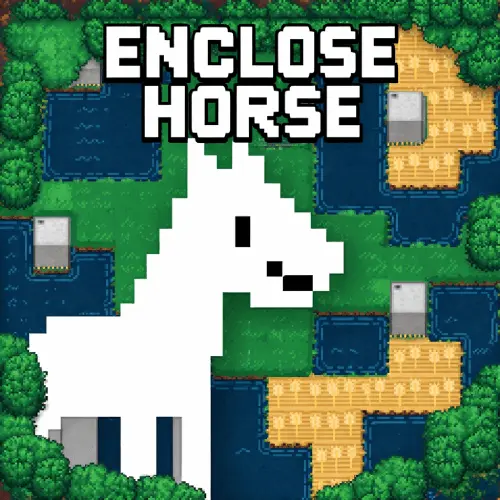
Enclose Horse is a daily puzzle game about building a safe enclosure for a roaming horse. Each board asks you to place fences on grass tiles, shape a…
 Works on Desktop & Mobile
Tested By BunaGames
- Test date
- August 2, 2026
- Tested on
- Chrome 150
- Device
- Desktop
- Operating system
- macOS and Windows
- Game loaded successfully
- Yes
- Fullscreen works
- Yes
- Sound works
- Yes
- Save progress
- Local browser storage
- Mobile compatibility
- Partially tested
- Keyboard controls
- Working
- Controller support
- Not detected
- Average loading time
- 4.2 seconds
- Known issues
- Minor delay after entering fullscreen
Enclose Horse not loading?
- Refresh the page.
- Disable restrictive content blockers temporarily.
- Confirm JavaScript and WebGL are enabled.
- Clear the browser cache.
- Try another modern browser.
- Close unnecessary tabs.
- Switch off VPN if the game server is blocked.
- Use the Report a Problem button if the issue continues.
Related Games
Continue Playing
Daily Challenge

Play 4 minutes today in Enclose Horse.
Leaderboard
- 1Community rating4.7 ★
- 2Player likes771
- 3Total votes827
- 4Your local progress0%
Your progress is saved locally in this browser. No account required.
 Your progress is saved locally in this browser. No account required.
How to Play
Begin by looking at the entire board instead of placing a fence beside the horse immediately. Identify the horse, the grass tiles available for wall placement, and any cherries, apples, or portals that may matter to the route and score. Then determine the attractor the horse is moving toward and trace its likely orthogonal path. Since diagonal movement is not available, you can think of the board as connected rows and columns.
Next, count your fence resource mentally. Limited walls mean every placement should serve a purpose. A productive fence either blocks a meaningful exit, channels the horse toward the area you intend to enclose, or contributes to the eventual boundary of the largest meadow. Avoid isolated walls that do not redirect a route or connect naturally to a future pen.
Place fences by clicking grass tiles. After a placement, reassess the horse's expected movement rather than assuming your original route prediction remains correct. A newly blocked direct route can force the horse to backtrack or choose another available path. This is the heart of the puzzle: each action modifies the movement map for the next turn.
Build toward a complete enclosure, not just a temporary slowdown. Leave enough room for the horse to occupy a proper meadow, but do not leave an open corridor that lets it escape. If fruit or portals are present, include them in your board reading before sealing the final boundary. Their presence can make one enclosure plan more valuable than another.
A reliable way to think through a puzzle is:
- Where does the horse want to go now?
- Which few walls change that route most efficiently?
- What area will those walls eventually surround?
- Can the horse still leave through a horizontal or vertical gap?
- Does the finished meadow preserve worthwhile scoring opportunities?
Solving with this order helps prevent a common mistake: spending too many fences early and discovering that there are not enough left to complete the outer boundary.
On mobile: use on-screen buttons or gestures when the game supports them.
 On mobile: use on-screen buttons or gestures when the game supports them.
Controls
- ↑Jump
- ← →Move Left / Right
- ↓Crouch
- W / ↑Climb / Interact
- S / ↓Drop / Slide
Enclose Horse uses simple point-and-click puzzle controls. The key interaction is selecting a grass tile to place a fence. Precision matters because one wall can alter the horse's route and the shape of the enclosure you can build afterward.
| Action | Control |
|---|---|
| Place a fence | Click a grass tile |
| Plan a route | Inspect board paths |
| Assess movement | Watch each turn |
Before clicking, scan the neighboring tiles and consider whether the new fence blocks a direct route, creates a channel, or simply wastes part of the limited wall supply. There is no need for rapid input. Enclose Horse rewards deliberate clicks and careful observation more than speed.
A mouse gives clear tile selection on larger boards, while a trackpad can also support the same click-based approach. Take a moment between fence placements to re-evaluate the horse's possible horizontal and vertical movement.
Game Progress & Challenges
Why Play This Game?
 Instant PlayPlay instantly in your browser.
 Free to PlayNo hidden fees.
About "Enclose Horse"
Enclose Horse is a daily puzzle game about building a safe enclosure for a roaming horse. Each board asks you to place fences on grass tiles, shape a meadow, and use a limited supply of walls efficiently. The central challenge is not simply trapping the horse in the smallest possible area: strong solutions aim to create the biggest useful pen while accounting for how the horse moves from turn to turn.
The puzzle combines grid planning, movement prediction, and score-minded route design. Horses move toward an attractor, so every fence placement can change the path available to them. Cherries, apples, and portals add important scoring and planning context, turning a simple-looking fence puzzle into a careful spatial problem. A wall that looks helpful immediately may also cut off a future route or shrink the meadow you are trying to protect.
Enclose Horse suits players who enjoy compact daily challenges with clear rules and room for optimization. It is a browser-focused puzzle experience: read the board, identify the horse's likely direction, then build an enclosure that balances safety, space, and collectible opportunities. If you enjoy thoughtful grid-based browser games, this is a concise puzzle built around planning ahead rather than quick reactions.
Gameplay
Every Enclose Horse puzzle starts with a horse on a grass-tile board and a restricted number of fences. Your job is to click suitable grass tiles to place walls and form an enclosure. Because the wall supply is limited, the board is not solved by covering every possible route. The important decision is where a short fence line creates the greatest control over the horse's movement.
The horse advances each turn toward an attractor. Early movement can appear straightforward because it heads directly toward its goal, but the route may change when a wall blocks that direct path. This makes the game a prediction puzzle: consider the horse's next move, the route it may take after a barrier appears, and the area that will remain inside the finished meadow. Horses do not move diagonally, which makes the horizontal and vertical tile routes especially important.
Large meadows are a major scoring objective, but size is only part of the decision. Cherries and apples can improve the value of a route, while portals introduce another board element to consider when evaluating where the horse can go. Rather than treating these objects as decoration, examine them before placing the first fence. They can influence which side of the board is worth preserving and which paths should remain open temporarily.
A successful round usually follows a deliberate sequence:
- Read the horse's immediate direction and available orthogonal routes.
- Locate grass tiles where a fence can redirect movement with minimal wall use.
- Reserve enough open area to create a large final meadow.
- Account for fruit and portals before closing the last escape route.
- Review whether the enclosure is safe without sacrificing unnecessary space.
This creates a useful tension: the safest-looking fence pattern is not always the highest-scoring one, and the largest-looking meadow is not always safe if the horse still has a path out.
Platform
Enclose Horse is presented as a browser puzzle game, making it a natural fit for players who want to open a daily grid challenge without treating it like a long campaign. The interaction is based on selecting board tiles to place fences, so a mouse or trackpad is the clearest way to work through a puzzle.
The game format is especially well suited to desktop and laptop browsing, where you can inspect the full board, trace horizontal and vertical routes, and pause before committing a fence. A larger display can make it easier to compare possible enclosure shapes, especially on boards containing fruit or portals.
As a daily puzzle, Enclose Horse also works well as a short planning break. The goal is to understand one board deeply rather than rush through many interchangeable levels. You can approach it like a logic puzzle: study the available tiles, test the consequences of a wall placement, and refine your understanding of the horse's route.
For more quick-play titles organized around web access, browse the BunaGames collection of online games.
How to Play "Enclose Horse"
Begin by looking at the entire board instead of placing a fence beside the horse immediately. Identify the horse, the grass tiles available for wall placement, and any cherries, apples, or portals that may matter to the route and score. Then determine the attractor the horse is moving toward and trace its likely orthogonal path. Since diagonal movement is not available, you can think of the board as connected rows and columns.
Next, count your fence resource mentally. Limited walls mean every placement should serve a purpose. A productive fence either blocks a meaningful exit, channels the horse toward the area you intend to enclose, or contributes to the eventual boundary of the largest meadow. Avoid isolated walls that do not redirect a route or connect naturally to a future pen.
Place fences by clicking grass tiles. After a placement, reassess the horse's expected movement rather than assuming your original route prediction remains correct. A newly blocked direct route can force the horse to backtrack or choose another available path. This is the heart of the puzzle: each action modifies the movement map for the next turn.
Build toward a complete enclosure, not just a temporary slowdown. Leave enough room for the horse to occupy a proper meadow, but do not leave an open corridor that lets it escape. If fruit or portals are present, include them in your board reading before sealing the final boundary. Their presence can make one enclosure plan more valuable than another.
A reliable way to think through a puzzle is:
- Where does the horse want to go now?
- Which few walls change that route most efficiently?
- What area will those walls eventually surround?
- Can the horse still leave through a horizontal or vertical gap?
- Does the finished meadow preserve worthwhile scoring opportunities?
Solving with this order helps prevent a common mistake: spending too many fences early and discovering that there are not enough left to complete the outer boundary.
Controls
Enclose Horse uses simple point-and-click puzzle controls. The key interaction is selecting a grass tile to place a fence. Precision matters because one wall can alter the horse's route and the shape of the enclosure you can build afterward.
| Action | Control |
|---|---|
| Place a fence | Click a grass tile |
| Plan a route | Inspect board paths |
| Assess movement | Watch each turn |
Before clicking, scan the neighboring tiles and consider whether the new fence blocks a direct route, creates a channel, or simply wastes part of the limited wall supply. There is no need for rapid input. Enclose Horse rewards deliberate clicks and careful observation more than speed.
A mouse gives clear tile selection on larger boards, while a trackpad can also support the same click-based approach. Take a moment between fence placements to re-evaluate the horse's possible horizontal and vertical movement.
Can "Enclose Horse" Unblocked?
Enclose Horse is a browser-oriented puzzle game, so the core appeal is being able to play from a web browser rather than needing to approach it as a traditional installed game. Its daily-puzzle format also makes it practical for a short session when you want a focused logic challenge based on a single board.
“Unblocked” can mean different things to different players. On a normal available connection, browser games are convenient because they are accessed through the web. However, school, workplace, library, or managed networks may apply their own content filters or access rules. Those restrictions are controlled by the network administrator, not by the puzzle's fence mechanics or gameplay design.
The best way to enjoy Enclose Horse is on a permitted connection and compatible browser environment. Once the board is available, the game itself is straightforward to approach: inspect the grid, click grass tiles to place fences, and plan a safe meadow around the horse. No special gamepad knowledge is required for the documented click-based interaction.
Because each puzzle is built around careful observation rather than reflex timing, it is also a good choice for a calm, short browser-gaming session. Give yourself enough screen space to read routes, especially when fruit and portals appear on the board.
Tips for "Enclose Horse"
Read movement before building. The horse moves toward an attractor each turn, so the first useful skill is predicting its immediate direction. Do not place a wall just because it is next to the horse. First ask whether that wall actually changes the route or whether the horse can continue around it through another orthogonal path.
Use fences as a connected plan. Limited walls make disconnected, decorative-looking barriers expensive. Try to place each fence as part of a future boundary, a corridor, or a route redirection. A single wall is strongest when it removes a meaningful option and also helps form the eventual enclosure.
Protect area, not merely proximity. It can be tempting to make a tight pen quickly. Yet the game emphasizes building the largest meadow, so a tiny enclosure may be safe but low value. Look for natural board edges and existing route constraints that let you surround more grass with fewer fences.
Trace only legal movement lines. Horses cannot move diagonally. When checking for an escape, follow horizontal and vertical possibilities tile by tile. This simple rule makes some apparent gaps harmless while making long open corridors more dangerous than they initially seem.
Plan around score elements early. Cherries, apples, and portals are part of the puzzle context, not afterthoughts. Before closing the pen, decide whether your enclosure shape should preserve access to fruit or account for a portal-related route. A late realization can force an inefficient fence placement or leave a valuable area outside the meadow.
Expect rerouting after a block. A horse may initially move directly toward its goal and then backtrack after its route is obstructed. This means a fence can have a delayed strategic effect. Watch how the board changes after each turn instead of assuming the horse will remain on its first path.
Save the final wall decision. If several routes remain possible, avoid committing your last available fence until you know which corridor matters most. The final closure should remove the real escape route while preserving the meadow you worked to create.
Features "Enclose Horse"
Enclose Horse centers on a compact set of puzzle systems that create meaningful decisions without overwhelming the board. The most important feature is fence placement on grass tiles. This gives every puzzle a tangible construction element: you are not only predicting movement, but also drawing the boundary that defines the horse's safe space.
The daily-puzzle structure gives the game a focused purpose. Instead of relying on endless repetition, each session can be approached as a fresh planning problem. That format supports careful experimentation, route analysis, and score improvement without requiring a long time commitment.
- Fence-building puzzle play: Click grass tiles to place walls and shape a pen.
- Limited wall resource: Use a finite number of fences efficiently.
- Horse movement planning: Predict routes toward an attractor and react to rerouting.
- Orthogonal navigation: Horses cannot move diagonally.
- Large-meadow objective: Build a spacious enclosure rather than only a small trap.
- Score context: Cherries, apples, and portals add value and route considerations.
- Browser puzzle format: Designed around accessible grid inspection and click-based input.
The strongest feature combination is the relationship between safety and score. A player can understand the basic task immediately—keep the horse enclosed—but better results require more advanced spatial reasoning. You must judge which grass should remain inside the boundary, which route should stay open for now, and when a fence changes movement in your favor.
Portals add another layer of board awareness. Along with apples and cherries, they encourage players to inspect the full layout before acting. This helps Enclose Horse feel less like a basic maze and more like an enclosure-design puzzle where movement, area, and scoring elements interact.
Best "Enclose Horse" Similar Games & Top Picks
- Candy Riddles: Play Candy Riddles, a free browser match-3 puzzle with colorful candies, cute cookies, and satisfying three-or-more matches.
- Color Sort: Play Color Sort online for free. Pour and organize mixed colored liquids into matching test tubes in this focused puzzle game.
- Screw Puzzle: Play Screw Puzzle online. Remove bolts, use open holes wisely, and solve satisfying logic challenges in your browser.
- 1010 Deluxe: Play 1010 Deluxe free in your browser. Drag colorful block shapes onto the 10x10 grid and clear complete rows and columns.
- Hexa Puzzle: Play Hexa Puzzle online for free. Study the target layout, drag pieces to swap positions, and solve each visual puzzle.
FAQ - Enclose Horse
What is Enclose Horse?
Enclose Horse is a daily puzzle game about keeping horses safe inside an enclosure. Players place fences on grass tiles to build a meadow, control the horse's available routes, and pursue a strong score. The puzzle is based on planning space efficiently rather than acting quickly.
What is the main goal in Enclose Horse?
The main goal is to enclose the horse while building the largest useful meadow possible. A complete solution needs to prevent the horse from escaping, but a high-quality solution also makes good use of the available grass and limited fence supply. Cherries, apples, and portals can add scoring and route-planning considerations.
How do I place fences?
Click grass tiles to place walls. Before making a placement, consider whether the fence blocks a meaningful route and whether it can become part of the final boundary. Because walls are limited, every fence should contribute to redirecting the horse, closing a route, or forming the meadow enclosure.
How does the horse move?
The horse moves on every turn toward an attractor. It may begin by moving directly toward that goal, then backtrack or reroute if a fence blocks the original path. Horses do not move diagonally, so route planning should focus on horizontal and vertical tile connections.
Why are fences limited?
The limited number of walls is a core puzzle constraint. If fences were unlimited, enclosing the horse would mostly be a matter of covering routes. With a fixed supply, players must find placements that do several jobs at once: redirect movement, create a boundary, and preserve enough area for a large meadow.
What do cherries, apples, and portals do?
Cherries, apples, and portals are board elements connected to scoring and puzzle planning. Their presence means you should examine the full board before sealing the enclosure. They can affect which area you want to preserve, which route is worth directing the horse toward, and how you evaluate the value of a completed meadow.
Can horses move diagonally in Enclose Horse?
No. Horses cannot move diagonally. This is useful when planning because you can evaluate possible movement as a network of up, down, left, and right routes. A diagonal-looking opening does not automatically create an escape route, while an open row or column can become a much more important path.
Is Enclose Horse a daily browser puzzle?
Yes. Enclose Horse is described as a daily puzzle game and is presented as a browser puzzle experience. Its format is well suited to a short session: study the board, place fences carefully, observe how the horse responds, and work toward a larger, safer enclosure.
More Games Like This
 4 Pics 1 Word
Puzzle ★ 4.5
4 Pics 1 Word
Puzzle ★ 4.5
 Jewel Quest
Puzzle ★ 4.7
Jewel Quest
Puzzle ★ 4.7
 Woodoku
Puzzle ★ 4.6
Woodoku
Puzzle ★ 4.6
 1010 Block Puzzle Game
Puzzle ★ 4.7
1010 Block Puzzle Game
Puzzle ★ 4.7
 Hexa Puzzle
Puzzle ★ 4.7
Hexa Puzzle
Puzzle ★ 4.7
 1010 Deluxe
Puzzle ★ 4.6
1010 Deluxe
Puzzle ★ 4.6
 Screw Puzzle
Puzzle ★ 4.7
Screw Puzzle
Puzzle ★ 4.7
 Color Sort
Puzzle ★ 4.6
Color Sort
Puzzle ★ 4.6
 Candy Riddles
Puzzle ★ 4.6
Candy Riddles
Puzzle ★ 4.6
 Hex Frvr
Puzzle ★ 4.5
Hex Frvr
Puzzle ★ 4.5
 Water Sort
Puzzle ★ 4.6
Water Sort
Puzzle ★ 4.6
 Brain Test Tricky Puzzles
Puzzle ★ 4.8
Brain Test Tricky Puzzles
Puzzle ★ 4.8
 Ball Sort
Puzzle ★ 4.5
Ball Sort
Puzzle ★ 4.5
 Bolts And Nuts
Puzzle ★ 4.6
Bolts And Nuts
Puzzle ★ 4.6
 Wheres My Water
Puzzle ★ 4.7
Wheres My Water
Puzzle ★ 4.7
 Hexagon
Puzzle ★ 4.6
Hexagon
Puzzle ★ 4.6
 Cut The Rope 2
Puzzle ★ 4.4
Cut The Rope 2
Puzzle ★ 4.4
 Fnaf 2
Puzzle ★ 4.5
Fnaf 2
Puzzle ★ 4.5
 Report a Problem
Comments About Enclose Horse