



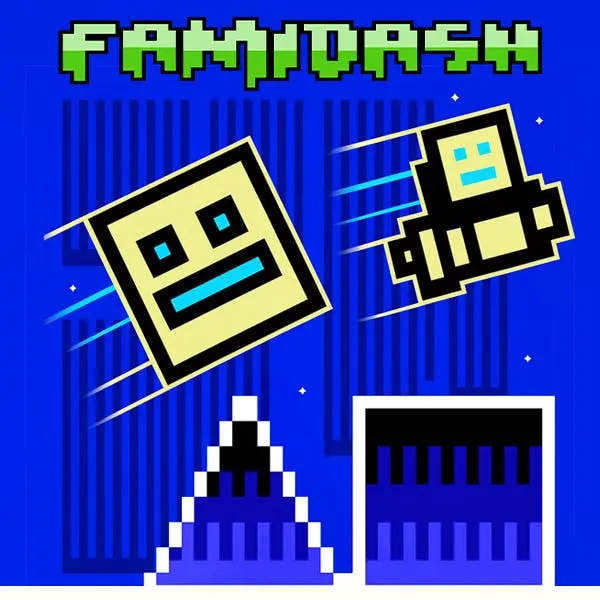
FamiDash
FamiDash is a rhythm-based action platform game built around one demanding idea: make the right jump at the right moment. Its fast obstacle courses and retro presentation draw…
 Works on Desktop & Mobile
Tested By BunaGames
- Test date
- August 2, 2026
- Tested on
- Chrome 150
- Device
- Desktop
- Operating system
- macOS and Windows
- Game loaded successfully
- Yes
- Fullscreen works
- Yes
- Sound works
- Yes
- Save progress
- Local browser storage
- Mobile compatibility
- Partially tested
- Keyboard controls
- Working
- Controller support
- Not detected
- Average loading time
- 4.2 seconds
- Known issues
- Minor delay after entering fullscreen
FamiDash not loading?
- Refresh the page.
- Disable restrictive content blockers temporarily.
- Confirm JavaScript and WebGL are enabled.
- Clear the browser cache.
- Try another modern browser.
- Close unnecessary tabs.
- Switch off VPN if the game server is blocked.
- Use the Report a Problem button if the issue continues.
Related Games
Continue Playing
Daily Challenge

Play 4 minutes today in FamiDash.
Leaderboard
- 1Community rating4.7 ★
- 2Player likes700
- 3Total votes754
- 4Your local progress0%
Your progress is saved locally in this browser. No account required.
 Your progress is saved locally in this browser. No account required.
How to Play
Start FamiDash with the expectation that each level is a precision route. Watch the opening section closely, then make the jump input when a hazard, gap, or raised surface requires it. Your objective is to keep clearing the course until the level is complete.
The most effective way to play is to separate learning from finishing. On an early attempt, do not worry if you fail quickly. Use that attempt to identify what caused the failure. Did you jump before reaching the edge? Did you react after the obstacle was already too close? Did two jumps need to be made as a faster sequence? A specific answer gives the next run a purpose.
- Begin a level and observe the first obstacle pattern.
- Use the game’s jump input to clear gaps and hazards.
- Restart after a mistake and repeat the opening sequence consistently.
- Memorize the next unfamiliar section as you reach it.
- Link practiced sections together into one complete run.
Rhythm is a practical tool, not just part of the game’s genre. If a series of jumps follows a recognizable cadence, silently counting the beats can help prevent rushed inputs. Visual cues are equally important: use obstacle spacing, platform edges, and the position of upcoming hazards to judge when to act.
Since there are no checkpoints, avoid treating every restart as lost progress. Each restart is a fresh chance to improve the opening and carry that consistency farther. The player benefit of this approach is clear: rather than depending on luck, you build a repeatable understanding of the level.
On mobile: use on-screen buttons or gestures when the game supports them.
 On mobile: use on-screen buttons or gestures when the game supports them.
Controls
- ↑Jump
- ← →Move Left / Right
- ↓Crouch
- W / ↑Climb / Interact
- S / ↓Drop / Slide
FamiDash uses a simple control concept: trigger a jump when the route demands one. The challenge is not a large list of actions; it is the precision of the input. A single late, early, or unnecessary jump can end an attempt, especially when hazards appear close together.
Before beginning a serious run, check the game screen for the available jump prompt and use the input indicated there. This is the best way to confirm the control method for the version currently loaded in your browser. Once confirmed, keep your attention on the course rather than repeatedly looking away from the play area.
- Primary action: use the displayed jump input.
- Timing goal: jump in response to upcoming gaps and obstacles.
- Best practice: use deliberate presses rather than panicked repeated input.
- Restart mindset: after a failure, identify the timing error before trying again.
Because the game is rhythm-based, consistent input matters more than speed alone. A controlled jump sequence usually performs better than reacting at the last possible instant. If a section feels too fast, practice reaching it repeatedly until the pattern becomes familiar.
Game Progress & Challenges
Why Play This Game?
 Instant PlayPlay instantly in your browser.
 Free to PlayNo hidden fees.
About "FamiDash"
FamiDash is a rhythm-based action platform game built around one demanding idea: make the right jump at the right moment. Its fast obstacle courses and retro presentation draw inspiration from Geometry Dash while reimagining the experience with a classic Nintendo Entertainment System-style look. Instead of exploring large worlds or fighting enemies, the challenge comes from reading the course, learning its rhythm, and surviving a continuous run.
Every stage asks for close attention. Spikes, gaps, raised platforms, and other hazards appear in carefully arranged sequences, so a jump that is correct in one moment can be too early or too late in the next. The game rewards repetition, pattern recognition, and calm reactions more than random experimentation.
FamiDash is especially suited to players who enjoy precision platformers, score-chasing practice, retro game aesthetics, and difficult rhythm challenges. Its no-checkpoint structure gives each successful finish extra weight: a mistake sends you back to the beginning of the current attempt, making improvement visible from run to run.
The result is a compact but intense platforming test. Learn the route, trust the timing, and turn a sequence that first feels impossible into a controlled rhythm run.
Gameplay
FamiDash gameplay centers on forward-moving, rhythm-guided platforming. Your main job is to jump over hazards and gaps while maintaining the timing needed to reach the next safe section. The course does not slow down to explain every threat, so players must quickly connect what they see with the action required.
That simple goal creates a high-skill loop. A run begins with observation: notice where obstacles sit, how much space separates them, and which jumps happen in quick succession. The next attempts become more deliberate as you remember the pattern. Eventually, the route starts to feel less like a set of isolated traps and more like a sequence of beats.
The game is described as having no checkpoints. This means dying does not resume the level near the most recent obstacle; the attempt begins again. While that structure is unforgiving, it also keeps the focus on consistency. To finish, it is not enough to solve a difficult late jump once. You need to execute the earlier sections reliably enough to reach it again.
FamiDash includes a reported set of 12 original levels associated with Geometry Dash creator RobTop, plus 3 additional community-made levels. This gives players a mix of established rhythm-platform patterns and extra material beyond the core selection. Each level is best approached as a learnable route rather than a race to improvise through on the first try.
- Read hazards before reacting to them.
- Use repetition to memorize jump sequences.
- Expect tight timing and rapid restarts.
- Treat rhythm as a guide for movement decisions.
Platform
FamiDash is known for translating a modern rhythm-platforming concept into a retro, NES-inspired format. That platform identity matters because the game does not merely use pixel-style graphics as decoration; its presentation emphasizes the look and feel of a classic console challenge while retaining fast obstacle-based play.
On BunaGames, FamiDash is presented as a browser game, allowing players to start a run from a compatible web browser rather than treating it as a traditional cartridge-only experience. The game’s straightforward structure also makes it a natural fit for short sessions: begin a level, practice the difficult sequence, and return later when you want another attempt.
The browser format is useful for players looking for quick access to browser games with focused gameplay. Still, FamiDash is not a casual game in the sense of being effortless. Its accessible format gets you into a level quickly, while the level design supplies the real challenge.
Because the experience depends heavily on timing, play in a setting where you can concentrate and where your browser is running smoothly. A clear view of the game area and uninterrupted input are more helpful than rushing through a first attempt.
How to Play "FamiDash"
Start FamiDash with the expectation that each level is a precision route. Watch the opening section closely, then make the jump input when a hazard, gap, or raised surface requires it. Your objective is to keep clearing the course until the level is complete.
The most effective way to play is to separate learning from finishing. On an early attempt, do not worry if you fail quickly. Use that attempt to identify what caused the failure. Did you jump before reaching the edge? Did you react after the obstacle was already too close? Did two jumps need to be made as a faster sequence? A specific answer gives the next run a purpose.
- Begin a level and observe the first obstacle pattern.
- Use the game’s jump input to clear gaps and hazards.
- Restart after a mistake and repeat the opening sequence consistently.
- Memorize the next unfamiliar section as you reach it.
- Link practiced sections together into one complete run.
Rhythm is a practical tool, not just part of the game’s genre. If a series of jumps follows a recognizable cadence, silently counting the beats can help prevent rushed inputs. Visual cues are equally important: use obstacle spacing, platform edges, and the position of upcoming hazards to judge when to act.
Since there are no checkpoints, avoid treating every restart as lost progress. Each restart is a fresh chance to improve the opening and carry that consistency farther. The player benefit of this approach is clear: rather than depending on luck, you build a repeatable understanding of the level.
Controls
FamiDash uses a simple control concept: trigger a jump when the route demands one. The challenge is not a large list of actions; it is the precision of the input. A single late, early, or unnecessary jump can end an attempt, especially when hazards appear close together.
Before beginning a serious run, check the game screen for the available jump prompt and use the input indicated there. This is the best way to confirm the control method for the version currently loaded in your browser. Once confirmed, keep your attention on the course rather than repeatedly looking away from the play area.
- Primary action: use the displayed jump input.
- Timing goal: jump in response to upcoming gaps and obstacles.
- Best practice: use deliberate presses rather than panicked repeated input.
- Restart mindset: after a failure, identify the timing error before trying again.
Because the game is rhythm-based, consistent input matters more than speed alone. A controlled jump sequence usually performs better than reacting at the last possible instant. If a section feels too fast, practice reaching it repeatedly until the pattern becomes familiar.
Can "FamiDash" Unblocked?
FamiDash is available on its BunaGames page as a browser-play experience, so players can access the game without needing to search for a separate console release to begin practicing its rhythm-platform challenges. Open the page in a supported browser, allow the game area to load, and start a level when it is ready.
The term “unblocked” can mean different things depending on where you are playing. BunaGames can provide browser access, but local network policies, school or workplace filters, device restrictions, and browser settings are controlled by the network or device administrator. Those restrictions may affect whether a game page loads in a particular location.
For the smoothest session, use a normal personal browsing environment when permitted, keep the game tab active, and avoid unnecessary background activity. FamiDash requires concentration because its levels rely on fast visual recognition and exact jump timing. A stable, distraction-free setup helps more than repeatedly switching between tabs.
If you simply want a focused retro platform challenge that starts in the browser, FamiDash offers a direct route into difficult obstacle-running gameplay without adding complex setup to the learning process.
Tips for "FamiDash"
FamiDash rewards methodical practice. The most useful tip is to stop thinking of a failed run as a total loss. In a no-checkpoint platformer, every death can reveal one piece of the route: the correct takeoff point, the pace of a two-jump sequence, or the visual cue that signals an upcoming danger.
- Learn one segment at a time. Make the opening safe and repeatable before worrying about a later obstacle.
- Watch the spacing. The distance between hazards often tells you whether a jump should be immediate, delayed, or followed by another jump quickly.
- Use a steady rhythm. Counting a pattern mentally can help when several obstacles form a recognizable sequence.
- Do not overcorrect. A rushed extra input can be as damaging as a missed jump.
- Stay calm after progress. Reaching a new section is useful, but excitement can disrupt the timing you used to get there.
- Identify the exact error. “I failed” is less helpful than “I jumped before the edge” or “I hesitated at the second spike.”
New players often focus entirely on the obstacle that caused the latest failure. Instead, look one step earlier. A poor landing, a mistimed previous jump, or a rushed approach may have created the bad position. This backward analysis is an information gain that turns repeated attempts into genuine improvement.
When a difficult sequence finally works, try to repeat it immediately on later attempts. The goal is not merely to prove that a jump is possible; it is to make it dependable enough to preserve a full run. FamiDash becomes more manageable when you replace reactive play with practiced movement patterns.
Features "FamiDash"
FamiDash combines recognizable rhythm-platforming fundamentals with a distinct retro-console identity. Its design is built for players who want a concise, skill-focused challenge rather than an open-ended adventure. The core loop is easy to understand, but finishing levels requires accuracy, memory, and persistence.
- Rhythm-based platforming: obstacle clearing depends on jump timing and route awareness.
- Retro NES-inspired presentation: the game frames its action through a classic Nintendo Entertainment System-style concept.
- Precision obstacle courses: players navigate hazards, gaps, and tightly arranged platform sequences.
- No checkpoints: failed attempts restart the level, emphasizing consistency and mastery.
- Level variety: the reported selection includes 12 original levels associated with RobTop and 3 community-made levels.
- Fast restart learning loop: repeated attempts let players study and improve individual patterns.
- Browser access: the BunaGames version is suited to players who want to begin playing through a web browser.
The no-checkpoint design is the feature that most strongly shapes the experience. It makes success demanding, but it also gives every completed run a clear sense of accomplishment. Players cannot rely on a late-level save point to carry them through; they need to understand the route from its opening moments through its final hazards.
Another useful feature is the game’s directness. There is little distance between starting an attempt, failing, recognizing a timing issue, and trying again. That compact feedback cycle makes FamiDash a strong match for players who enjoy improving measurable skills through repetition. Its retro style supports the experience without replacing the central appeal: carefully timed platforming under pressure.
Best "FamiDash" Similar Games & Top Picks
- Dig Dug 2: Play Dig Dug 2 online and clear island rounds in the 1985 Namco arcade sequel with overhead action and strategic enemy encounters.
- Big Tower Tiny Square: Play Big Tower Tiny Square online. Climb past lava, bullets, and traps to reach the top and rescue the stolen pineapple.
- Stickman Parkour: Play Stickman Parkour online and master 30 side-scrolling levels filled with spikes, water, ropeways, keys, chests, and platforms.
- Meat Boy: Play Meat Boy online for free on BunaGames. Enjoy fast platform timing and precision jumps directly in your browser with quick access and simple…
- Geometry Dash Scratch: Play Geometry Dash Scratch online. Explore a Scratch-made Geometry Dash-style platform game, learn how it works, and improve your timing.
FAQ - FamiDash
What is FamiDash?
FamiDash is a rhythm-based action platform game with a retro Nintendo Entertainment System-inspired presentation. It is built around jumping over hazards, crossing gaps, learning obstacle patterns, and surviving complete levels through precise timing.
Is FamiDash inspired by Geometry Dash?
Yes. FamiDash is presented as a retro interpretation of the Geometry Dash-style rhythm platform format. The shared appeal is timing jumps to obstacle patterns, while FamiDash emphasizes an NES-inspired visual and platform identity.
How do you play FamiDash?
Play by using the jump input shown on the game screen to clear obstacles and gaps. Watch the layout ahead, act at the right moment, and learn the route through repeated attempts. The goal is to complete the level without being stopped by a hazard.
Does FamiDash have checkpoints?
No. FamiDash is described as having no checkpoints. When an attempt ends, you begin again rather than resuming near the place where you failed. This makes memorization and consistent execution especially important.
Why is FamiDash difficult?
The difficulty comes from precise timing, quick obstacle sequences, and the lack of checkpoints. A player must not only discover how to pass a hard section, but also repeat the earlier portions well enough to reach that section again. Progress comes from pattern recognition and controlled practice.
How many levels are in FamiDash?
The reported level set includes 12 original levels associated with Geometry Dash creator RobTop and 3 extra levels made by the community. This gives players core rhythm-platform stages along with additional community-created challenges.
Can I play FamiDash in a browser?
Yes. The BunaGames page provides FamiDash as a browser-play game. Load the game page in a supported browser, wait for the game area to become ready, and use the on-screen control prompt to begin playing.
What is the best beginner strategy for FamiDash?
Focus on one section at a time. First, make the opening sequence reliable. Then use each restart to learn the next obstacle pattern. Try to identify whether an error came from jumping too early, too late, or adding an unnecessary input. A steady rhythm and deliberate practice are more effective than rushing through repeated attempts.
More Games Like This
 Meat Boy
Platform ★ 4.4
Meat Boy
Platform ★ 4.4
 Big Tower Tiny Square
Platform ★ 4.5
Big Tower Tiny Square
Platform ★ 4.5
 Dig Dug 2
Platform ★ 4.4
Dig Dug 2
Platform ★ 4.4
 Geometry Dash Scratch
Platform ★ 4.7
Geometry Dash Scratch
Platform ★ 4.7
 Papa Louie 2
Platform ★ 4.7
Papa Louie 2
Platform ★ 4.7
 Geometry Dash Subzero
Platform ★ 4.5
Geometry Dash Subzero
Platform ★ 4.5
 Vex 7
Platform ★ 4.6
Vex 7
Platform ★ 4.6
 Fire And Water
Platform ★ 4.6
Fire And Water
Platform ★ 4.6
 I Am Cat
Platform ★ 4.7
I Am Cat
Platform ★ 4.7
 Pixel Slime
Platform ★ 4.7
Pixel Slime
Platform ★ 4.7
 Stickman Climb 2
Platform ★ 4.6
Stickman Climb 2
Platform ★ 4.6
 Om Nom Jump
Platform ★ 4.6
Om Nom Jump
Platform ★ 4.6
 G-Switch 4
Platform ★ 4.7
G-Switch 4
Platform ★ 4.7
 Tower Of Destiny
Platform ★ 4.7
Tower Of Destiny
Platform ★ 4.7
 Parkour Block 3D
Platform ★ 4.4
Parkour Block 3D
Platform ★ 4.4
 Super Mario Run
Platform ★ 4.7
Super Mario Run
Platform ★ 4.7
 Jump Only
Platform ★ 4.6
Jump Only
Platform ★ 4.6
 Candy Jump
Platform ★ 4.5
Candy Jump
Platform ★ 4.5
 Report a Problem
Comments About FamiDash