



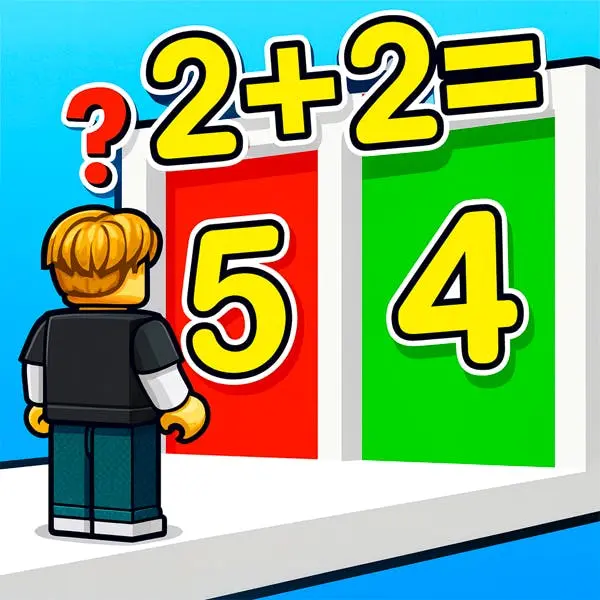
Math Wall Simulator
Math Wall Simulator turns arithmetic into a forward-moving puzzle challenge. Instead of treating sums as isolated questions, the game connects each calculation to progress: solve the problem, open…
 Works on Desktop & Mobile
Tested By BunaGames
- Test date
- June 22, 2026
- Tested on
- Chrome 150
- Device
- Desktop
- Operating system
- macOS and Windows
- Game loaded successfully
- Yes
- Fullscreen works
- Yes
- Sound works
- Yes
- Save progress
- Local browser storage
- Mobile compatibility
- Partially tested
- Keyboard controls
- Working
- Controller support
- Not detected
- Average loading time
- 4.2 seconds
- Known issues
- Minor delay after entering fullscreen
Math Wall Simulator not loading?
- Refresh the page.
- Disable restrictive content blockers temporarily.
- Confirm JavaScript and WebGL are enabled.
- Clear the browser cache.
- Try another modern browser.
- Close unnecessary tabs.
- Switch off VPN if the game server is blocked.
- Use the Report a Problem button if the issue continues.
Related Games
Continue Playing
Daily Challenge

Play 7 minutes today in Math Wall Simulator.
Leaderboard
- 1Community rating4.7 ★
- 2Player likes1.2K
- 3Total votes1.3K
- 4Your local progress0%
Your progress is saved locally in this browser. No account required.
 Your progress is saved locally in this browser. No account required.
How to Play
Start Math Wall Simulator by looking at the arithmetic problem that is blocking your route. The objective is to solve the sum correctly so that you can open gates, clear walls, and reach the next room or stage of progress. Each problem is an obstacle and a clue: identify the operation first, calculate the result second, then use the game’s displayed answer method to submit your solution.
- Read the full equation. Check the numbers and the operation sign before calculating.
- Identify the math type. Decide whether the question asks for addition, subtraction, multiplication, or division.
- Work out the result. Use mental math, number facts, or a quick double-check before committing.
- Answer using the active game interface. Follow the prompt shown in the version you are playing.
- Advance through the obstacle. Correct answers are used to open gates and continue into the next area.
- Collect progression rewards. Keep an eye on coins and wins as you move forward.
Once you understand that answers drive movement, the game becomes easier to read. Do not treat every question as a separate test; treat it as the next required action in a route. A gate represents the next opportunity to progress, while a wall represents a mathematical barrier that must be cleared through correct problem solving.
As you earn coins and wins, you may be able to obtain cosmetics, pets, and calculators. These rewards support the longer-term progression loop, but the essential skill never changes: solve the arithmetic accurately. If a question feels difficult, slow down long enough to verify the operation and result. One careful answer is more valuable than guessing at a wall that controls the next part of the run.
On mobile: use on-screen buttons or gestures when the game supports them.
 On mobile: use on-screen buttons or gestures when the game supports them.
Controls
- ↑Jump
- ← →Move Left / Right
- ↓Crouch
- W / ↑Climb / Interact
- S / ↓Drop / Slide
The verified game descriptions explain the math objective but do not publish a fixed keyboard, mouse, touch, or controller mapping. Because online versions can present their answer interface differently, the safest method is to follow the visible prompts after the game loads.
The most important player input is the mathematical answer. Before interacting, make sure you have read the equation correctly and identified its operation. The interface will indicate how that version expects an answer to be entered or selected.
- Math prompt: Read the displayed equation before acting.
- Answer input: Use the option or entry method shown on the active game screen.
- Progress action: A correct result supports opening gates or clearing the way forward.
- Reward choices: Use the game’s displayed menus when spending coins or wins on available items.
Avoid assuming that a control method from another version will apply everywhere. If the game provides an instruction panel, that on-screen guidance is the authoritative control reference for your session. The strongest control habit is still cognitive: pause briefly, solve the sum, and submit only when the result makes sense.
Game Progress & Challenges
Why Play This Game?
 Instant PlayPlay instantly in your browser.
 Free to PlayNo hidden fees.
About "Math Wall Simulator"
Math Wall Simulator turns arithmetic into a forward-moving puzzle challenge. Instead of treating sums as isolated questions, the game connects each calculation to progress: solve the problem, open the gate or clear the obstacle, and move toward the next area. Addition, subtraction, multiplication, and division are central to the experience, making quick number recognition just as important as accurate calculation.
The main appeal is its simple loop of question, answer, progress, and reward. Math problems stand between the player and the next room, so every correct solution has a visible purpose. As the journey continues, walls and gates make the arithmetic feel more immediate than a standard worksheet-style quiz.
Progression also matters. The game includes coins, wins, cosmetics, pets, and calculators as collectible or purchasable rewards. That gives players reasons to keep solving beyond one gate: build up progress, collect items, and see how far a careful run can go. It is a focused choice for players looking for browser games with puzzle-solving at the center rather than pure reflex action.
Whether you want a light way to practice basic operations or a fast challenge built around mental math, the objective remains clear: read the equation, work out the result, and keep advancing through the walls.
Gameplay
Math Wall Simulator is built around arithmetic barriers. A math question appears as part of the route forward, and solving it allows the player to open gates and advance into the next room or section. The repeated cycle creates a practical goal for each calculation: an answer is not merely marked correct; it helps remove what is blocking progress.
The question pool is based on the four familiar operations:
- Adding numbers accurately without overlooking place value.
- Subtracting carefully, especially when the values are close together.
- Multiplying with recall of number facts and products.
- Dividing by identifying the correct quotient.
Walls give the game its simulator-style identity. Players are working through a path where mathematical answers support wall destruction and access to new areas. This blends a puzzle-game decision with a sense of movement and progression. The best approach is usually measured rather than rushed: a fast incorrect calculation does not help if it prevents the next gate from opening.
Coins and wins extend the core loop. By progressing through the math obstacles, players can collect coins and build wins, then use rewards on cosmetics, pets, and calculators. These progression items make repeated play more meaningful while the arithmetic remains the key requirement for advancement.
The game is therefore useful for two types of player. Puzzle fans can focus on route progression and rewards, while learners can repeatedly engage with addition, subtraction, multiplication, and division in a goal-driven setting. The important gameplay skill is not advanced theory; it is consistent, accurate mental calculation under the motivation of reaching the next wall or room.
Platform
Math Wall Simulator is presented as a free online game, so its main appeal is immediate browser-based access rather than a long installation process. Open the game page, start the session, and focus on the arithmetic challenge. This format suits short play breaks as well as longer attempts to collect rewards and push farther through the available progression.
The game is associated with online play experiences that center on math questions, gates, rooms, and walls. Because the provided game information does not publish a verified list of supported operating systems, browsers, or device-specific control schemes, it is best to use a current browser and follow the instructions displayed by the game version when it loads.
Browser access is especially convenient for players who want a compact puzzle activity without needing to download a separate application. The core content remains the same idea regardless of session length: solve arithmetic prompts, unlock the way forward, and continue earning progress through successful answers.
For the smoothest experience, allow the game page to finish loading before starting. If an embedded game does not begin normally, refreshing the page or checking that the browser is permitted to run the game can help. No account requirement is confirmed here, so players should rely on the on-page prompts for any sign-in or saving options.
How to Play "Math Wall Simulator"
Start Math Wall Simulator by looking at the arithmetic problem that is blocking your route. The objective is to solve the sum correctly so that you can open gates, clear walls, and reach the next room or stage of progress. Each problem is an obstacle and a clue: identify the operation first, calculate the result second, then use the game’s displayed answer method to submit your solution.
- Read the full equation. Check the numbers and the operation sign before calculating.
- Identify the math type. Decide whether the question asks for addition, subtraction, multiplication, or division.
- Work out the result. Use mental math, number facts, or a quick double-check before committing.
- Answer using the active game interface. Follow the prompt shown in the version you are playing.
- Advance through the obstacle. Correct answers are used to open gates and continue into the next area.
- Collect progression rewards. Keep an eye on coins and wins as you move forward.
Once you understand that answers drive movement, the game becomes easier to read. Do not treat every question as a separate test; treat it as the next required action in a route. A gate represents the next opportunity to progress, while a wall represents a mathematical barrier that must be cleared through correct problem solving.
As you earn coins and wins, you may be able to obtain cosmetics, pets, and calculators. These rewards support the longer-term progression loop, but the essential skill never changes: solve the arithmetic accurately. If a question feels difficult, slow down long enough to verify the operation and result. One careful answer is more valuable than guessing at a wall that controls the next part of the run.
Controls
The verified game descriptions explain the math objective but do not publish a fixed keyboard, mouse, touch, or controller mapping. Because online versions can present their answer interface differently, the safest method is to follow the visible prompts after the game loads.
The most important player input is the mathematical answer. Before interacting, make sure you have read the equation correctly and identified its operation. The interface will indicate how that version expects an answer to be entered or selected.
- Math prompt: Read the displayed equation before acting.
- Answer input: Use the option or entry method shown on the active game screen.
- Progress action: A correct result supports opening gates or clearing the way forward.
- Reward choices: Use the game’s displayed menus when spending coins or wins on available items.
Avoid assuming that a control method from another version will apply everywhere. If the game provides an instruction panel, that on-screen guidance is the authoritative control reference for your session. The strongest control habit is still cognitive: pause briefly, solve the sum, and submit only when the result makes sense.
Can "Math Wall Simulator" Unblocked?
Math Wall Simulator is designed around online play, which makes it a practical option when you want a quick arithmetic puzzle in a browser. Availability can still depend on the network, browser settings, device rules, or content policies in the location where you are playing. A school, workplace, library, or managed network may restrict gaming pages independently of the game itself.
If the game page is accessible, you can play the core challenge without treating it as a download-only experience. Let the page load, check the displayed instructions, and begin solving the questions that lead through gates and walls. The game’s clear arithmetic loop also makes it suitable for short sessions: solve a few obstacles, collect progress where possible, and return later for another attempt.
Do not use workarounds to bypass local network restrictions. Instead, play where online games are permitted and use the access options available through your normal browser. If the game does not load, a refresh, an updated browser, or permission to run the game may resolve ordinary technical issues.
Players searching for an unblocked math game usually want fast access and a simple challenge. Math Wall Simulator delivers the challenge through addition, subtraction, multiplication, and division, while the actual access status depends on the rules of the network being used.
Tips for "Math Wall Simulator"
The most reliable way to progress in Math Wall Simulator is to value accuracy before speed. Since equations control gates and walls, a correct answer keeps the route moving. Build a short mental routine for every problem: inspect the operation, calculate, then verify whether the result is reasonable.
- Read symbols first. Confusing multiplication with addition or division with subtraction changes the whole problem. Identify the operation before looking for an answer.
- Use number facts. Recall common multiplication pairs and division facts instead of calculating every question from the beginning.
- Estimate before answering. A rough estimate can catch obvious mistakes. For example, if two positive numbers are added, the result should not be smaller than either starting number.
- Break larger sums apart. For addition, combine tens and ones mentally. For multiplication, use known products where possible.
- Check subtraction direction. Look carefully at which number comes first. Reversing the order can produce the wrong result.
- Verify division with multiplication. When possible, multiply the proposed quotient by the divisor to see whether it recreates the original amount.
- Keep rewards in perspective. Coins, wins, cosmetics, pets, and calculators provide progression goals, but correct arithmetic is what opens the route.
For younger or less confident players, it can help to say the equation silently in words before solving it. Turning a symbol into a sentence, such as “twelve divided by three,” reduces the chance of overlooking the operation. For experienced players, focus on avoiding rushed errors during repeated questions.
Another useful strategy is to notice patterns. Repeated multiplication tables, complementary addition pairs, and familiar division facts can make later walls faster to clear. The game rewards a calm rhythm: read, solve, confirm, advance. That rhythm is more sustainable than trying to race through every obstacle without checking the numbers.
Features "Math Wall Simulator"
Math Wall Simulator combines basic arithmetic practice with a progression-focused obstacle format. Its features work together to make math questions feel connected to a visible game goal rather than appearing as standalone drills.
- Four core operations: Solve addition, subtraction, multiplication, and division questions.
- Gate progression: Correct solutions open gates and help you reach the next room or area.
- Wall-focused challenge: Math answers are tied to destroying or clearing walls that block advancement.
- Coins and wins: Earn progression resources while working through the game’s obstacles.
- Collectible rewards: Coins and wins can be used for cosmetics, pets, and calculators.
- Goal-driven practice: Each calculation has an immediate gameplay purpose: moving forward.
- Short-session friendly format: The question-and-progress loop is easy to understand when you want a compact online puzzle session.
The strongest feature is the connection between arithmetic and movement. In many math games, getting an answer right simply produces a score. Here, solving questions supports access to the next gate, room, or wall challenge. That creates a clearer feedback loop: calculate correctly, see the route open, and continue building rewards.
The reward layer adds a second reason to keep playing. Cosmetics can personalize the experience, while pets and calculators are part of the available item progression. At the same time, these rewards do not replace the central mechanic. To gain momentum, players still need to solve the sums that stand in the way.
This balance gives Math Wall Simulator a useful niche among online puzzle games. It is approachable because the math categories are familiar, but it remains engaging because the questions are embedded in a wall-clearing and room-advancing structure. Players can use it for casual mental-math practice, progression collecting, or a simple challenge based on quick and accurate calculation.
Best "Math Wall Simulator" Similar Games & Top Picks
- Brian Test 4: Sneaky Friends: Play Brian Test 4: Sneaky Friends online and solve cartoon riddles with careful taps, lateral thinking, and smart puzzle strategies.
- Brain Test 3: Tricky Puzzles: Play Brain Test 3: Tricky Puzzles online. Solve reverse-logic riddles, collect useful items, and follow a story through tricky quests.
- Brain Test 2: Tricky Puzzles: Play Brain Test 2: Tricky Puzzles online free. Read quirky riddles, study hand-drawn scenes, and solve clever brain teasers.
- Idle Dice: Play Idle Dice online and roll for earnings. Learn the gameplay, controls, dice-combo strategy, browser access, and save options.
- Unblock Me: Play Unblock Me online and slide the wooden blocks aside to guide the red block out of the board.
FAQ - Math Wall Simulator
What is Math Wall Simulator?
Math Wall Simulator is an online arithmetic puzzle game built around solving math questions to progress. Players work through addition, subtraction, multiplication, and division problems in order to open gates, clear or destroy walls, and advance to the next room or area.
Its main game loop links correct answers to movement. Rather than answering questions only for a score, you use successful calculations to remove obstacles in the path ahead.
What kinds of math questions are in the game?
The game includes the four basic arithmetic operations: addition, subtraction, multiplication, and division. These are the supported question types described for the game, so useful skills include mental calculation, multiplication-table recall, and checking whether an answer is reasonable.
Before answering, identify the operation symbol first. This simple step prevents many mistakes when questions appear quickly.
How do you advance in Math Wall Simulator?
You advance by solving the displayed math questions correctly. Correct solutions allow you to open gates and move into the next room or continue past walls. The exact answer-entry method should be taken from the on-screen interface in the version you are playing.
The practical objective is to keep the route open through accurate arithmetic. If a wall or gate blocks progress, focus on the related equation and verify the result before submitting it.
Can you earn rewards in Math Wall Simulator?
Yes. The game includes coins and wins as progression rewards. These can be used to obtain cosmetics, pets, and calculators. Rewards provide an extra collection and progression layer alongside the core math-solving challenge.
Even with collectibles available, arithmetic remains the main requirement. Solving questions is what supports forward movement through gates, rooms, and walls.
Is Math Wall Simulator free to play online?
Math Wall Simulator is presented as a free online game. This means players can access the main browser-based experience without relying on a separate download-only format. Actual access can depend on whether the page is allowed by the network and browser being used.
If a location restricts gaming content, availability may differ. Always follow local device and network rules rather than trying to bypass restrictions.
What are the controls for Math Wall Simulator?
A single verified universal control layout is not provided. The essential interaction is solving the math prompt and using the answer method shown on the active game screen. Different online versions may display their input options differently.
When the game loads, use its visible instructions as the guide for answering questions, navigating any reward menus, and interacting with the current session.
Is Math Wall Simulator good for practicing math?
It can be a useful way to engage with basic arithmetic because it repeatedly uses addition, subtraction, multiplication, and division in a goal-driven context. The game encourages players to calculate carefully because correct answers open the next part of the route.
It is best viewed as practice through gameplay, not as a replacement for formal instruction. Players can improve their confidence by slowing down, checking operations, and recognizing familiar number patterns.
What should I do if I make a math mistake?
Pause and reassess the equation instead of rushing into another guess. Check the operation sign, read the numbers again, and use a quick estimate to see whether your result is plausible. For division, multiply the proposed answer by the divisor; for subtraction, consider whether the result fits the order of the numbers.
A steady routine of read, calculate, check, and answer is the most dependable way to keep progressing through Math Wall Simulator.
More Games Like This
 4 Pics 1 Word
Puzzle ★ 4.5
4 Pics 1 Word
Puzzle ★ 4.5
 Jewel Quest
Puzzle ★ 4.7
Jewel Quest
Puzzle ★ 4.7
 Woodoku
Puzzle ★ 4.6
Woodoku
Puzzle ★ 4.6
 1010 Block Puzzle Game
Puzzle ★ 4.7
1010 Block Puzzle Game
Puzzle ★ 4.7
 Hexa Puzzle
Puzzle ★ 4.7
Hexa Puzzle
Puzzle ★ 4.7
 1010 Deluxe
Puzzle ★ 4.6
1010 Deluxe
Puzzle ★ 4.6
 Screw Puzzle
Puzzle ★ 4.7
Screw Puzzle
Puzzle ★ 4.7
 Color Sort
Puzzle ★ 4.6
Color Sort
Puzzle ★ 4.6
 Candy Riddles
Puzzle ★ 4.6
Candy Riddles
Puzzle ★ 4.6
 Hex Frvr
Puzzle ★ 4.5
Hex Frvr
Puzzle ★ 4.5
 Water Sort
Puzzle ★ 4.6
Water Sort
Puzzle ★ 4.6
 Brain Test Tricky Puzzles
Puzzle ★ 4.8
Brain Test Tricky Puzzles
Puzzle ★ 4.8
 Ball Sort
Puzzle ★ 4.5
Ball Sort
Puzzle ★ 4.5
 Bolts And Nuts
Puzzle ★ 4.6
Bolts And Nuts
Puzzle ★ 4.6
 Wheres My Water
Puzzle ★ 4.7
Wheres My Water
Puzzle ★ 4.7
 Hexagon
Puzzle ★ 4.6
Hexagon
Puzzle ★ 4.6
 Cut The Rope 2
Puzzle ★ 4.4
Cut The Rope 2
Puzzle ★ 4.4
 Papas Sushiria
Puzzle ★ 4.6
Papas Sushiria
Puzzle ★ 4.6
 Report a Problem
Comments About Math Wall Simulator