


Tag Game
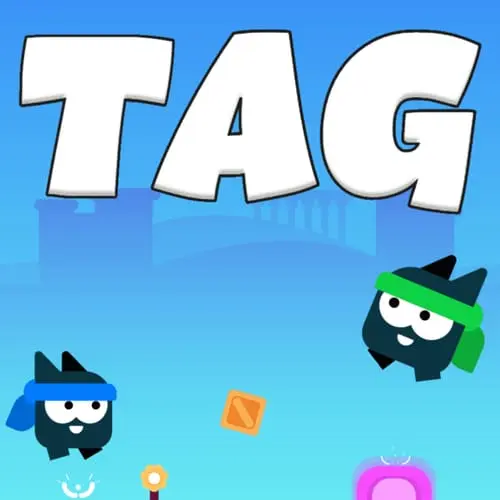
Tag Game transforms the classic playground chase into a competitive local multiplayer arcade experience designed for 2 to 4 players. One participant assumes the role of the tagger,…
 Works on Desktop & Mobile
Tested By BunaGames
- Test date
- May 27, 2026
- Tested on
- Chrome 150
- Device
- Desktop
- Operating system
- macOS and Windows
- Game loaded successfully
- Yes
- Fullscreen works
- Yes
- Sound works
- Yes
- Save progress
- Local browser storage
- Mobile compatibility
- Partially tested
- Keyboard controls
- Working
- Controller support
- Not detected
- Average loading time
- 4.2 seconds
- Known issues
- Minor delay after entering fullscreen
Tag Game not loading?
- Refresh the page.
- Disable restrictive content blockers temporarily.
- Confirm JavaScript and WebGL are enabled.
- Clear the browser cache.
- Try another modern browser.
- Close unnecessary tabs.
- Switch off VPN if the game server is blocked.
- Use the Report a Problem button if the issue continues.
Continue Playing
Daily Challenge

Play 4 minutes today in Tag Game.
Leaderboard
- 1Community rating4.5 ★
- 2Player likes566
- 3Total votes649
- 4Your local progress0%
Your progress is saved locally in this browser. No account required.
 Your progress is saved locally in this browser. No account required.
Game Progress & Challenges
Why Play This Game?
 Instant PlayPlay instantly in your browser.
 Mobile FriendlyOptimized for all devices.
 Free to PlayNo hidden fees.
About "Tag Game"
Tag Game transforms the classic playground chase into a competitive local multiplayer arcade experience designed for 2 to 4 players. One participant assumes the role of the tagger, hunting opponents across varied maps while others sprint, dodge, and outmaneuver to avoid capture. This digital adaptation of tag emphasizes spatial awareness, reaction timing, and tactical positioning within confined arena boundaries. Unlike passive online games, Tag Game demands constant movement and split-second decision-making as roles reverse with each successful tag, creating dynamic momentum shifts that keep every round unpredictable.
Gameplay
Tag Game operates on a rotating tagger system where the active chaser must physically contact opponents to transfer the tagger role. Each round begins with one designated player as the pursuer while remaining participants scatter across the map terrain. The tagger's objective centers on closing distance and making contact before time expires or opponents exploit map geometry for evasion. Once tagged, the touched player immediately becomes the new chaser, forcing instant tactical recalibration.
Map layouts introduce environmental variables including obstacles, narrow corridors, and open zones that favor either pursuit or escape depending on positioning. Successful evasion requires reading the tagger's movement patterns, baiting directional commits, and using terrain features to break line-of-sight. The gameplay loop rewards both aggressive pursuit strategies and defensive corner-cutting techniques, with match outcomes determined by cumulative tagging efficiency across timed sessions.
Platform
Tag Game runs directly in modern web browsers without installation requirements, delivering immediate access through standard HTML5 technology. The game supports desktop and laptop play via keyboard controls, optimized for local multiplayer sessions where participants share a single device or compete on separate machines within the same network environment. Cross-browser compatibility ensures consistent performance across Chrome, Firefox, Safari, and Edge, while responsive design adapts to various screen resolutions without compromising visibility or control precision. As one of many browser games, it eliminates download barriers and storage concerns, making it ideal for quick multiplayer sessions during breaks or casual gaming gatherings.
How to Play "Tag Game"
Launch Tag Game and select the number of participants from the 2-4 player range. The system randomly assigns the initial tagger role, marking that player with a distinct visual indicator. Non-tagger players immediately begin moving to establish distance from the chaser using directional controls.
The tagger pursues opponents by navigating toward their positions and initiating contact through collision detection. Upon successful tagging, the touched player's status changes to tagger while the previous chaser becomes a runner. All players continuously adjust strategies based on their current role—aggressive pursuit when tagged, evasive maneuvering when fleeing.
Rounds conclude after preset time limits or tag count thresholds, with performance tracked through tagging frequency metrics. Optimal play involves anticipating opponent movement vectors, controlling map chokepoints, and timing directional changes to maximize evasion duration or minimize chase time.
Controls
Tag Game employs keyboard-based directional input for player movement across the arena. Standard control schemes typically assign arrow keys or WASD configurations for navigation, allowing precise eight-directional movement or analog-style positioning depending on implementation.
- Movement Keys: Navigate your character using assigned directional inputs to chase opponents or evade the tagger
- Sprint/Boost: Some versions include temporary speed modifiers activated via spacebar or shift keys for tactical bursts
- Direction Changes: Rapid input reversals enable sharp turns and juking maneuvers critical for close-quarters evasion
Multiplayer sessions require each player to use separate key zones when sharing a keyboard, or individual input devices for simultaneous control without interference. Responsive input handling ensures movement commands translate immediately to on-screen action, maintaining the fast-paced tempo essential to competitive tagging dynamics.
Can "Tag Game" Unblocked?
Tag Game functions as an unblocked browser title accessible from networks with standard web restrictions, including educational institutions and workplace environments. The game's HTML5 architecture bypasses common firewall limitations that block executable downloads or plugin-dependent content. Direct browser execution means no administrative permissions or software installations trigger security protocols.
Players can access Tag Game through direct URL navigation without encountering typical gaming site blocks, as the lightweight codebase and absence of external dependencies avoid red-flag content filters. This accessibility makes it a practical choice for play free sessions during school breaks or office downtime, provided local network policies permit recreational browsing. The game's local multiplayer focus also eliminates concerns about persistent online connections or account registrations that might raise compliance issues in restricted environments.
Tips for "Tag Game"
- Corner Cutting: When evading, take tight angles around obstacles to force the tagger into wider pursuit arcs that increase separation distance
- Center Control: As the tagger, dominate central map positions to reduce escape routes and corner opponents against boundaries
- Predictive Positioning: Anticipate where fleeing players will move rather than chasing their current location, cutting off escape vectors before they materialize
- Momentum Baiting: Fake directional commits to make the tagger overcommit, then reverse course to exploit their momentum
- Obstacle Chains: Link multiple terrain features in evasion routes to create compound barriers that multiply the tagger's navigation challenges
- Role Transition Speed: Immediately shift mental state when tagged—hesitation after role changes wastes critical pursuit seconds
- Map Edge Awareness: Avoid getting trapped against boundaries where movement options collapse and tagging becomes inevitable
Features "Tag Game"
- Local Multiplayer Support: Accommodates 2-4 simultaneous players in shared-screen or networked sessions
- Dynamic Role Rotation: Automatic tagger reassignment upon each successful tag maintains continuous gameplay flow
- Multiple Map Layouts: Varied arena designs with distinct obstacle configurations and spatial challenges
- Visual Tagger Indicators: Clear on-screen markers distinguish the active chaser from fleeing players
- Browser-Native Execution: Zero-installation HTML5 implementation for instant access across devices
- Responsive Controls: Low-latency input handling preserves competitive integrity during high-speed chases
- Session Customization: Adjustable round timers and player counts adapt difficulty and pacing to group preferences
- Performance Tracking: Post-match statistics display tagging efficiency and evasion duration metrics
Best "Tag Game" Similar Games & Top Picks
- Dune Surfer Game: Play Dune Game in your browser on BunaGames. Learn how to start, check the controls, use practical tips, and understand the game page.
- Pokemon Emerald: Play Pokemon Emerald online and explore Hoenn, train Pokémon, battle rivals, build a team, and face Team Magma and Team Aqua.
- Boulder Dash: Play Boulder Dash online. Dig through caves, collect diamonds, avoid falling boulders, and plan every move in this classic puzzle game.
- Vib-Ribbon: Play Vib-Ribbon online and guide Vibri across beat-timed obstacle lines in this distinctive rhythm arcade game.
- Zombie Tsunami: Play Zombie Tsunami online and lead a growing zombie horde through city obstacles, pedestrians, destruction, and surprise power-ups.
FAQ - Tag Game
Can I play Tag Game solo or does it require multiple players?
Tag Game is designed exclusively for local multiplayer with 2-4 participants. The core chase-and-tag mechanic requires at least one tagger and one evader to function, making solo play impractical. The game's competitive dynamics emerge from human unpredictability and strategic interaction that AI opponents cannot replicate in this implementation.
Do all players need separate devices to play Tag Game?
Players can share a single keyboard using designated key zones for each participant, though this requires coordination to avoid input conflicts. Alternatively, connecting multiple input devices to one machine or playing across networked browsers on separate devices provides cleaner control separation. The game supports both shared-device and multi-device local multiplayer configurations.
How does the tagger role get assigned during gameplay?
The initial tagger is randomly selected at round start. After that, the role transfers automatically to any player who gets tagged by the current chaser. This creates a rotating tagger system where successful tags immediately shift pursuit responsibility, forcing constant tactical adaptation from all participants.
Are there different maps or just one arena layout?
Tag Game includes multiple map designs with varying obstacle placements, corridor widths, and open space distributions. Each layout favors different strategies—some reward aggressive pursuit through open areas, while others provide complex terrain for evasive maneuvering. Map variety prevents repetitive gameplay and requires players to adapt tactics to environmental conditions.
Does Tag Game work on mobile devices or only desktop browsers?
The game is optimized primarily for desktop and laptop browsers with keyboard controls. While technically accessible on mobile devices, the control scheme relies on keyboard input rather than touch interfaces, making mobile play impractical without external input peripherals. Desktop browsers provide the intended experience for competitive local multiplayer sessions.
More Games Like This
 Ball Surfer 3D
Arcade ★ 4.7
 Galaga
Arcade ★ 4.7
 Osu Game
Arcade ★ 4.7
 Dig Dug 2
Arcade ★ 4.4
 Pac Xon
Arcade ★ 4.8
 Colorbox Mustard
Arcade ★ 4.6
 Blumgi Slime
Arcade ★ 4.7
 Rolling Ball 3D
Arcade ★ 4.7
 Burrito Bison
Arcade ★ 4.6
 Dumb Ways To Die 2
Arcade ★ 4.8
 Papas Sushiria
Arcade ★ 4.6
 Papas Wingeria
Arcade ★ 4.6
 Papas Scooperia
Arcade ★ 4.7
 Papas Pizzeria
Arcade ★ 4.6
 Papas Freezeria
Arcade ★ 4.6
 Crazy Roll 3D
Arcade ★ 4.6
 Papas Taco Mia
Arcade ★ 4.6
 Fnf Garcello
Arcade ★ 4.6
 Report a Problem
Comments About Tag Game