


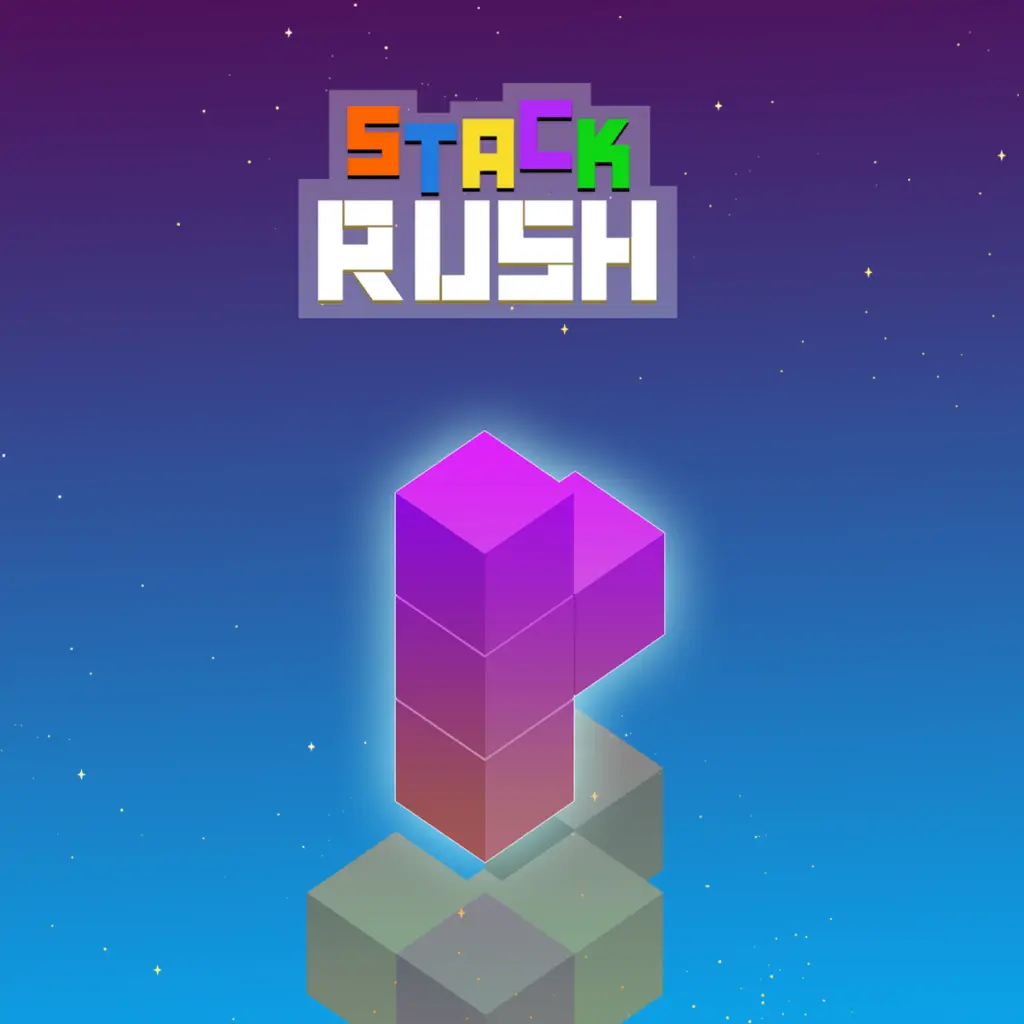
Stack Rush
Stack Rush is a 3D block-stacking puzzle game built around spatial awareness, quick decisions, and careful platform rotation. Instead of simply moving every falling piece across a flat…
 Works on Desktop & Mobile
Tested By BunaGames
- Test date
- June 23, 2026
- Tested on
- Chrome 150
- Device
- Desktop
- Operating system
- macOS and Windows
- Game loaded successfully
- Yes
- Fullscreen works
- Yes
- Sound works
- Yes
- Save progress
- Local browser storage
- Mobile compatibility
- Partially tested
- Keyboard controls
- Working
- Controller support
- Not detected
- Average loading time
- 4.2 seconds
- Known issues
- Minor delay after entering fullscreen
Stack Rush not loading?
- Refresh the page.
- Disable restrictive content blockers temporarily.
- Confirm JavaScript and WebGL are enabled.
- Clear the browser cache.
- Try another modern browser.
- Close unnecessary tabs.
- Switch off VPN if the game server is blocked.
- Use the Report a Problem button if the issue continues.
Continue Playing
Daily Challenge

Play 4 minutes today in Stack Rush.
Leaderboard
- 1Community rating4.7 ★
- 2Player likes589
- 3Total votes638
- 4Your local progress0%
Your progress is saved locally in this browser. No account required.
 Your progress is saved locally in this browser. No account required.
Game Progress & Challenges
Why Play This Game?
 Instant PlayPlay instantly in your browser.
 Mobile FriendlyOptimized for all devices.
 Free to PlayNo hidden fees.
About "Stack Rush"
Stack Rush is a 3D block-stacking puzzle game built around spatial awareness, quick decisions, and careful platform rotation. Instead of simply moving every falling piece across a flat board, you turn the cube-like play area to expose the side that gives the next shape the best landing space. The goal is to arrange the incoming blocks efficiently and complete full layers before uneven stacks leave too little room.
The game combines the immediate readability of a falling-block puzzle with a more three-dimensional challenge. Each rotation changes the visible surface and can reveal a cleaner route for a shape that looked difficult a moment earlier. That makes every placement a small planning problem: decide where the piece belongs now, then consider what its position will mean for the next pieces.
Stack Rush suits players looking for a focused casual puzzle game with short, replayable rounds. It rewards calm observation as much as reflexes. A fast turn can save an awkward placement, but a well-timed pause to inspect the platform can protect valuable open space and keep a run going longer.
Gameplay
In Stack Rush, blocks fall toward a rotatable 3D platform. Your main job is to turn that platform so each shape lands on a useful surface and contributes to a tidy structure. Shapes have different outlines, so a good landing is not always the closest available gap. A piece may fit better on another face of the cube, beside an existing block, or across a low area that needs to be leveled.
Complete layers are central to the puzzle. Filling a layer clears it, which removes accumulated material and restores room for future placements. This creates the main rhythm of play: assess the next block, rotate to a promising face, place it cleanly, and work toward a full layer before the structure becomes too tall or irregular.
The important twist is that rotation changes the landing geometry without changing the shape itself. Rather than treating every piece as a separate emergency, read the whole platform. Look for:
- flat surfaces that can support a block without creating holes;
- shallow gaps that match the current piece’s footprint;
- low sides that can be built toward a layer clear;
- overcrowded faces that should be avoided until space is recovered.
This gives Stack Rush a balance of pace and planning. The falling-block pressure keeps decisions moving, while the rotating platform gives you a meaningful way to solve difficult placements. Strong runs come from preserving flexible space, not from stacking as high as possible on one visible side.
Platform
Stack Rush is presented as an online browser puzzle game, so you can start a session directly on the game page without installing a separate app. The browser format is useful for quick breaks: open the page, learn the current board state, and begin placing blocks without a lengthy setup.
The game’s 3D view is especially important on a larger screen because the platform has multiple usable faces. Take a moment to read the depth of the stack and inspect the exposed sides before committing to a rotation. A clear view helps you notice empty cells, uneven ledges, and possible layer-completion routes.
For the smoothest experience, use a modern browser and allow the game page to finish loading before starting a run. If the game seems slow to respond, close unnecessary browser tabs or apps and reload the page. Reliable visual performance matters in Stack Rush because the best placement can depend on noticing a brief opening on another side of the platform.
How to Play "Stack Rush"
Start by watching the incoming block and identifying its shape. Do not focus only on the face currently in front of you. Stack Rush is designed around rotating the platform, so the first useful question is often: which side has the most practical landing area for this piece?
- Read the falling shape. Notice whether it needs a broad flat area, can fill a narrow gap, or can help level an uneven section.
- Inspect the platform. Check the visible surfaces for low spaces, open edges, and nearly complete layers.
- Rotate toward a better face. Turn the cube platform to bring the most suitable landing area into position.
- Place for stability. Aim for a landing that sits cleanly and does not create a difficult cavity underneath or beside the block.
- Build complete layers. Use consecutive pieces to fill a layer. Clearing layers is the most reliable way to regain room.
- Reassess after every drop. A placement changes more than one side of the structure, so scan the board again before deciding on the next rotation.
Early in a run, prioritize a broad, level base. As the structure grows, shift attention toward repair work: fill small openings, reduce steep height differences, and avoid adding blocks to an already crowded face unless that move completes a layer. If a piece does not fit your first idea, rotate deliberately rather than forcing it into the nearest space.
The game is easier to understand when you think in layers rather than towers. Height is not progress by itself. Useful progress means converting scattered blocks into a complete plane that can clear and reopen the platform.
Controls
Stack Rush uses a simple control concept: rotate the platform to guide falling blocks toward a better landing surface. The puzzle is not about freely reshaping each block; it is about choosing the right orientation of the 3D board at the right time.
Use the control prompts shown in the game window to rotate the platform during play. Pay attention to the direction of each turn, because a rotation can bring a useful side into view while moving another side out of immediate reach. Make deliberate inputs when the board is uneven, and use quicker adjustments when a clear gap is already available.
- Primary action: rotate the cube-like platform.
- Placement goal: guide falling shapes onto useful surfaces.
- Best habit: inspect the next landing area before making several rapid turns.
Since the board has depth, avoid judging a move only from the front-facing side. Rotate, check the newly exposed surface, and confirm that the landing will support your larger layer-clearing plan.
Can "Stack Rush" Unblocked?
Stack Rush is available to play in a browser through BunaGames, making it a convenient option when you want a quick 3D puzzle session without a separate download. Open the game page, wait for the game area to load, and begin rotating the platform to manage the falling blocks.
Whether a game is accessible on a school, work, library, or shared network depends on that network’s local rules and filtering settings. If the page does not open where you are, do not attempt to bypass restrictions. Try again later on a permitted personal connection or use another approved network.
Browser play is useful because a run can be short and self-contained. You can return to Stack Rush when you have time to focus on a few careful placements, practice reading the 3D surfaces, or try to clear layers more efficiently than in your previous attempt.
Tips for "Stack Rush"
The most effective Stack Rush strategy is to protect usable space. A block that lands quickly but creates an awkward hole may make several future pieces harder to place. Before rotating, ask whether the move improves the platform’s overall shape or merely hides a problem on another face.
- Build low and level. A flatter structure offers more possible landing positions and reduces the risk of isolated high points.
- Think in complete layers. A nearly full layer is valuable. Favor moves that finish it or make its remaining spaces easier to fill.
- Do not chase the nearest gap. The closest opening may be too narrow, too deep, or poorly positioned for the next block. Check other faces first.
- Avoid sealed cavities. Small holes beneath or between blocks can become unusable if later pieces cannot reach or match them.
- Use rotation as planning time. Turning the platform is not just a reaction. It helps reveal the board’s true shape and exposes alternative landing routes.
- Repair uneven sides early. If one face starts rising much faster than the rest, use suitable pieces to level it before it limits your options.
- Keep calm under pressure. Fast inputs are useful only when you already know the destination. Random spinning often turns a manageable board into a cluttered one.
One useful mental model is to treat each face as part of one shared storage space. A clean placement on one side can support a future layer clear elsewhere, while a messy edge can restrict several sides at once. Look beyond the immediate block and preserve at least one broad, accessible surface whenever possible.
If a run ends because the stack became irregular, review the point where the first difficult gap appeared. Often the real mistake was an earlier placement that created an unsupported ledge or split a large open area into several small spaces. Improving that one decision is more valuable than simply trying to rotate faster.
Features "Stack Rush"
Stack Rush centers on a clear but demanding 3D puzzle loop: falling blocks arrive, the platform rotates, and completed layers create valuable space. Its strongest feature is the way the rotating cube changes familiar block placement into a spatial puzzle with several visible surfaces to manage.
- 3D rotating platform: turn the play area to expose different landing faces and solve placement problems from new angles.
- Falling block puzzles: respond to shapes with different outlines and find stable places for each one.
- Layer-clearing objective: fill complete layers to remove built-up blocks and extend the run.
- Spatial planning: judge depth, height, gaps, edges, and accessible surfaces instead of relying on a single flat board.
- Reflex and focus challenge: make efficient decisions while new pieces keep the puzzle moving.
- Short replayable sessions: start a new attempt quickly and refine your approach to stacking, rotation, and space management.
- Browser convenience: play directly online when you want a compact casual puzzle experience.
The game also provides a useful distinction from ordinary stacking games: rotation is part of the solution, not just a visual effect. A shape that seems unplayable from one angle may have a clean destination after the platform turns. That means good players continually scan for hidden capacity rather than reacting only to the surface in front of them.
Stack Rush is a strong match for players who enjoy block puzzles but want more depth than a fixed rectangular grid. It remains easy to begin because the immediate aim is understandable—place blocks and clear layers—yet its changing perspectives create enough decision-making to reward practice.
Best "Stack Rush" Similar Games & Top Picks
- Papas Taco Mia: Play Papa's Taco Mia online. Take taco orders, cook seasoned meats, add toppings, earn coins, and improve your busy taqueria.
- Papas Cupcakeria: Play Papas Cupcakeria online. Take orders, bake cupcakes, add frosting and toppings, then serve each customer with care.
- Melon Playground: Play Melon Playground online, a creative ragdoll physics sandbox for building experiments with characters, tools, weapons, and vehicles.
- Incredibox: Play Incredibox online and build a layered beatbox mix with animated performers, beats, melodies, effects, voices, and bonuses.
- Blob Opera: Play Blob Opera online and conduct four AI-powered opera voices. Drag the singing blobs to create playful harmonies in your browser.
FAQ - Stack Rush
What is Stack Rush?
Stack Rush is a 3D falling-block puzzle game. You rotate a cube-like platform to guide differently shaped blocks onto useful surfaces, then work to fill and clear complete layers. The challenge comes from managing several sides of the platform rather than arranging pieces on one fixed flat board.
How do you clear layers in Stack Rush?
Layers clear when you fill them completely with blocks. Focus on making stable, connected placements that reduce gaps and level the structure. A cleared layer removes built-up material and gives you more room for the blocks that follow.
Do you rotate the blocks or the platform?
The defining mechanic is rotating the platform or screen view to change where a falling block can land. The block shapes remain the puzzle pieces you must accommodate, while the rotating board lets you expose a more suitable face, gap, or flat surface.
What is the best strategy for beginners?
Begin by keeping the stack low and even. Avoid leaving small holes or building one side much higher than the others. Look for placements that support a future complete layer, not just the current piece. When a placement seems awkward, inspect other faces before forcing the block into the first opening you see.
Is Stack Rush a Tetris-style game?
Stack Rush shares the falling-block and space-management ideas associated with Tetris-style puzzles, but it uses a 3D rotating platform. That extra dimension changes how you plan: you must consider exposed faces, depth, edges, and how a rotation affects the next available landing area.
Can I play Stack Rush in a browser?
Yes. Stack Rush is available as a browser game on BunaGames. You can open the game page and play online without needing to install a separate program. For the best experience, let the game finish loading and use a browser that runs the 3D game view smoothly.
Is Stack Rush free to play?
Stack Rush can be played online through BunaGames. Start the game from the page and focus on rotating the platform, placing blocks efficiently, and clearing layers during each run.
Why does my stack become difficult to manage?
Most difficult boards begin with uneven height, unsupported ledges, or small gaps that later shapes cannot fill. Since the platform has multiple faces, a messy placement can limit more than one area. Reassess the whole cube after each drop, repair uneven sections early, and preserve broad flat surfaces for future blocks.
More Games Like This
 Sprunki Retake 2
Casual ★ 4.8
Sprunki Retake 2
Casual ★ 4.8
 Sprunki Phase 3 Remastered
Casual ★ 4.7
Sprunki Phase 3 Remastered
Casual ★ 4.7
 Helix Jump
Casual ★ 4.6
Helix Jump
Casual ★ 4.6
 Sprunki Incredibox
Casual ★ 4.5
Sprunki Incredibox
Casual ★ 4.5
 Good Pizza Great Pizza
Casual ★ 4.7
Good Pizza Great Pizza
Casual ★ 4.7
 Eagle Craft
Casual ★ 4.7
Eagle Craft
Casual ★ 4.7
 Storm The House
Casual ★ 4.7
Storm The House
Casual ★ 4.7
 Papas Sushiria
Casual ★ 4.6
Papas Sushiria
Casual ★ 4.6
 Papas Wingeria
Casual ★ 4.6
Papas Wingeria
Casual ★ 4.6
 Papas Scooperia
Casual ★ 4.7
Papas Scooperia
Casual ★ 4.7
 Papas Pizzeria
Casual ★ 4.6
Papas Pizzeria
Casual ★ 4.6
 Papas Freezeria
Casual ★ 4.6
Papas Freezeria
Casual ★ 4.6
 Sled Rider 3D
Casual ★ 4.7
Sled Rider 3D
Casual ★ 4.7
 Fnaf
Casual ★ 4.5
Fnaf
Casual ★ 4.5
 Tropical Merge
Casual ★ 4.6
Tropical Merge
Casual ★ 4.6
 Flip Bottle
Casual ★ 4.6
Flip Bottle
Casual ★ 4.6
 Papas Taco Mia
Casual ★ 4.6
Papas Taco Mia
Casual ★ 4.6
 Farm Merge Valley
Casual ★ 4.7
Farm Merge Valley
Casual ★ 4.7
 Report a Problem
Comments About Stack Rush