



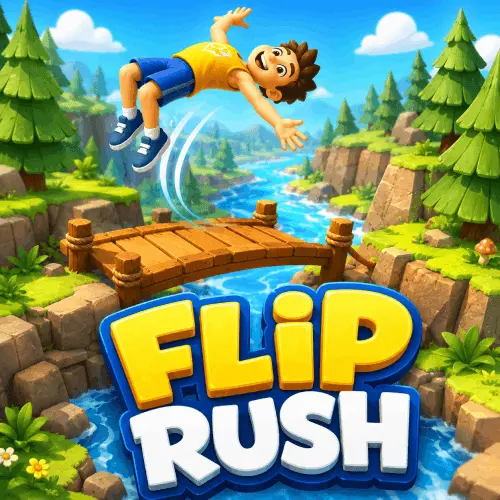
Flip Rush
Flip Rush is a physics-based stunt game that challenges players to control a ragdoll athlete through acrobatic sequences requiring precise timing and spatial awareness. Unlike traditional running games…
 Works on Desktop & Mobile
Tested By BunaGames
- Test date
- May 27, 2026
- Tested on
- Chrome 150
- Device
- Desktop
- Operating system
- macOS and Windows
- Game loaded successfully
- Yes
- Fullscreen works
- Yes
- Sound works
- Yes
- Save progress
- Local browser storage
- Mobile compatibility
- Partially tested
- Keyboard controls
- Working
- Controller support
- Not detected
- Average loading time
- 4.2 seconds
- Known issues
- Minor delay after entering fullscreen
Flip Rush not loading?
- Refresh the page.
- Disable restrictive content blockers temporarily.
- Confirm JavaScript and WebGL are enabled.
- Clear the browser cache.
- Try another modern browser.
- Close unnecessary tabs.
- Switch off VPN if the game server is blocked.
- Use the Report a Problem button if the issue continues.
Continue Playing

Daily Challenge

Play 5 minutes today in Flip Rush.
Leaderboard
- 1Community rating4.5 ★
- 2Player likes509
- 3Total votes579
- 4Your local progress0%
Your progress is saved locally in this browser. No account required.
 Your progress is saved locally in this browser. No account required.
Game Progress & Challenges
Why Play This Game?
 Instant PlayPlay instantly in your browser.
 Mobile FriendlyOptimized for all devices.
 Free to PlayNo hidden fees.
About "Flip Rush"
Flip Rush is a physics-based stunt game that challenges players to control a ragdoll athlete through acrobatic sequences requiring precise timing and spatial awareness. Unlike traditional running games that emphasize forward speed alone, this title centers on vertical momentum management and rotational control during airborne phases. Players launch from elevated platforms, execute mid-air rotations, and must calculate landing angles to touch down safely within designated zones. The ragdoll physics engine creates unpredictable movement dynamics that reward skillful input rather than memorized patterns, making each attempt a test of real-time adjustment and kinesthetic learning.
The game blends arcade accessibility with skill-based progression, offering a low barrier to entry while maintaining a high skill ceiling. As one of the online games focused on stunt mechanics rather than obstacle avoidance, it carves out a distinct niche in the browser gaming space by prioritizing rotational physics and landing precision over linear progression.
Gameplay
Core gameplay revolves around a three-phase loop: momentum building, aerial rotation, and controlled landing. Players begin each sequence on a platform where they must generate sufficient launch velocity. The jump initiates the aerial phase, during which rotational input determines flip speed and orientation. Success depends on calculating the correct number of rotations relative to flight time and landing zone distance.
The ragdoll physics model introduces limb articulation and center-of-mass shifts that affect rotation speed and landing stability. Unlike rigid character models, the ragdoll responds dynamically to input timing, meaning early or late flip commands produce different angular velocities. This creates a feedback loop where players develop muscle memory for specific platform heights and distances, learning to correlate visual cues with input timing.
Landing zones vary in size and placement, requiring players to adjust both horizontal trajectory and rotational count. Overshooting rotations results in head-first or back-first impacts that fail the attempt, while undershooting leaves the character off-balance. The game rewards clean landings—feet-first contact within the target area—with progression to more challenging platform configurations featuring greater heights, longer gaps, and smaller landing zones.
Platform
Flip Rush runs directly in web browsers without requiring downloads, installations, or platform-specific clients. The game utilizes HTML5 and WebGL technologies to deliver physics simulation and rendering through standard browser engines, making it accessible across desktop and laptop systems running Chrome, Firefox, Safari, and Edge.
Browser-based deployment eliminates compatibility barriers common to native applications, allowing instant access through a URL. Players can start sessions immediately without account creation or software management. The lightweight architecture ensures smooth performance on mid-range hardware, as the physics calculations and rendering demands remain modest compared to graphically intensive titles.
This delivery model positions Flip Rush among browser games that prioritize accessibility and session flexibility. Players can engage in quick attempts during breaks or extended practice sessions without commitment to large file downloads or system resource allocation. The platform-agnostic approach also supports cross-device play, though touch controls on mobile browsers may offer different precision characteristics compared to mouse or keyboard input on desktop systems.
How to Play "Flip Rush"
Begin by positioning your character on the starting platform. The objective is to reach the landing zone after performing the correct number of mid-air flips. Timing your jump determines initial velocity and flight arc, which directly affects how much airborne time you have for rotations.
Once airborne, initiate flips using the designated control input. Monitor your character's rotation relative to the remaining flight distance. The key challenge is synchronizing rotation count with descent rate so your character completes full flips and orients feet-downward as you approach the landing zone.
Successful landings require both positional accuracy and rotational alignment. Your character must land within the marked zone boundaries while maintaining an upright orientation. Partial rotations or off-angle landings typically result in failure, forcing a restart. As you progress, platforms increase in height and landing zones shrink, demanding tighter timing windows and more precise rotation control.
The ragdoll physics mean limb position affects stability. Compact rotations during flips help maintain predictable angular momentum, while extended limbs can create wobble that complicates landing alignment. Developing consistent input timing for each platform type becomes essential for advancing through increasingly difficult configurations.
Controls
The control scheme centers on two primary inputs: jump initiation and flip execution. Most browser implementations use mouse click or spacebar for jumping, with the same input or a secondary key triggering flips during the aerial phase. The simplicity of the control set keeps the focus on timing precision rather than complex input combinations.
Jump input determines launch force, though many versions use fixed jump power to standardize the challenge around rotation timing rather than variable launch strength. The flip input activates rotational momentum, with some implementations allowing continuous rotation while the key is held and others applying discrete flip increments per press.
Responsive input handling is critical due to the tight timing windows required for proper rotation counts. Input lag or delayed response can throw off the synchronization between rotation speed and descent rate, making clean landings difficult. The control system's directness—minimal steps between player intent and character action—supports the skill-based learning curve where improvement comes from refined timing rather than mastering complex command sequences.
Can "Flip Rush" Unblocked?
As a browser-based title requiring no executable downloads or plugin installations, Flip Rush typically remains accessible in environments where native gaming applications face restrictions. The game runs entirely within the browser sandbox, using standard web technologies that network administrators generally permit for normal web browsing activities.
Educational and workplace networks that block gaming platforms often focus on executable files, peer-to-peer connections, or high-bandwidth streaming services. Browser games using HTML5 and WebGL fall into the same technical category as interactive web content, making them less likely to trigger content filters designed to block traditional gaming traffic.
Players seeking access in restricted environments should verify that JavaScript and WebGL are enabled in their browser settings, as these technologies power the physics simulation and rendering. Some networks may implement domain-based filtering, but the game's lightweight resource footprint and lack of social or multiplayer features reduce the likelihood of administrative blocking compared to persistent-world or communication-heavy titles.
Tips for "Flip Rush"
- Calibrate timing on early platforms: Use simpler jumps to establish baseline timing between jump initiation and flip input. Consistent input rhythm transfers to harder stages.
- Count rotations visually: Track your character's orientation relative to the horizon. Knowing you need exactly two full rotations helps you judge when to stop flipping.
- Adjust for platform height: Taller platforms grant more airborne time, allowing additional flips. Recalibrate your rotation count as platform elevation increases.
- Prioritize landing zone center: Aiming for the middle of the landing area provides margin for error in both horizontal distance and rotational alignment.
- Watch descent speed: Faster falls require quicker rotation input. If you're dropping too fast, initiate flips earlier in the jump arc.
- Learn failure patterns: Note whether you're consistently over-rotating or under-rotating. Adjust flip timing incrementally rather than making large changes.
- Minimize limb extension: Keeping the ragdoll compact during rotations reduces unpredictable wobble that can destabilize landing orientation.
- Use visual landmarks: Identify background or platform features that correlate with optimal jump timing. Environmental cues can serve as timing references.
Features "Flip Rush"
- Ragdoll physics simulation: Dynamic limb articulation creates realistic movement responses and unpredictable challenge variations that prevent rote memorization.
- Skill-based progression: Advancement depends on player timing precision and spatial judgment rather than character upgrades or power-ups.
- Incremental difficulty scaling: Platform height, gap distance, and landing zone size increase gradually, maintaining challenge without sudden difficulty spikes.
- Instant restart mechanic: Failed attempts reset immediately, supporting rapid iteration and skill refinement without punitive delays.
- Minimal control complexity: Two-input system keeps focus on execution timing rather than command memorization, lowering entry barriers.
- Browser-native execution: No downloads or installations required, enabling immediate play sessions across compatible devices.
- Physics-driven outcomes: Landing success depends on real-time physics calculations rather than scripted animations, rewarding precise player input.
- Visual clarity: Clean presentation ensures players can easily track character orientation, rotation count, and landing zone position during fast-paced aerial sequences.
Best "Flip Rush" Similar Games & Top Picks
- Marble Run 3D: Race a country marble through 3D tracks, avoid hazards, collide with rivals, and reach the finish line in Marble Run 3D.
- Marble Run: Play Marble Run online and build physics-based tracks with drops, loops, obstacles, and rolling marbles in your browser.
- Plonky: Play Plonky free in your browser. Guide a wobbly hero through traps, ropes, bars, and physics-based puzzle levels.
- TEMPLE RUN 2: Autumn: Run through the autumn jungle, avoid temple obstacles, collect treasure, and chase a higher distance in Temple Run 2: Autumn.
- TEMPLE RUN 2: Holi Festival: Run through a colorful Holi Festival route, avoid traps, collect coins, use power-ups, and stay ahead of demonic monkeys.
FAQ - Flip Rush
Is Flip Rush free to play in a browser?
Yes, Flip Rush is available as a free browser game requiring no downloads, subscriptions, or payment to access core gameplay. You can play free directly through compatible web browsers on desktop systems.
What makes Flip Rush different from other running games?
Unlike traditional running games focused on forward movement and obstacle avoidance, Flip Rush emphasizes vertical momentum, rotational control, and landing precision. The ragdoll physics system creates dynamic movement challenges centered on timing and spatial awareness rather than reflexive dodging.
How do I perform successful flips and landings?
Successful landings require synchronizing your rotation count with flight time. Initiate flips after jumping, monitor your character's orientation during descent, and ensure you complete full rotations to land feet-first within the target zone. Timing your flip input relative to platform height and landing distance is the core skill.
Can I play Flip Rush on mobile devices?
The game runs in browsers supporting HTML5 and WebGL, which includes many mobile browsers. However, touch controls may offer different precision characteristics compared to mouse or keyboard input on desktop systems, potentially affecting timing accuracy.
What controls does Flip Rush use?
The game typically uses simple two-input controls: one for jumping (often spacebar or mouse click) and one for initiating flips during the aerial phase. The minimal control scheme focuses gameplay on timing precision rather than complex input combinations.
Does Flip Rush require fast reflexes or strategic planning?
The game blends both elements. You need quick reflexes to execute properly timed flips during short aerial windows, but also strategic planning to calculate the correct rotation count based on platform height and landing zone distance. Success comes from developing muscle memory for specific platform configurations.
Why do my landings fail even when I reach the landing zone?
Landing failures typically result from incorrect rotational alignment. Even if you reach the target area, landing on your head, back, or side instead of feet-first constitutes a failed attempt. The ragdoll physics require both positional accuracy and proper orientation for successful landings.
How does the ragdoll physics affect gameplay?
The ragdoll model introduces limb articulation and center-of-mass dynamics that affect rotation speed and landing stability. Unlike rigid characters, the ragdoll responds to input timing with variable angular momentum, creating a skill-based challenge where consistent input produces consistent results but requires practice to master.
More Games Like This
 Papas Sushiria
mobile ★ 4.6
 Papas Wingeria
mobile ★ 4.6
 Papas Scooperia
mobile ★ 4.7
 Papas Pizzeria
mobile ★ 4.6
 Papas Freezeria
mobile ★ 4.6
 Papas Taco Mia
mobile ★ 4.6
 Papas Cupcakeria
mobile ★ 4.6
 Hello Neighbor
mobile ★ 4.7
 sprunki phase 8
mobile ★ 4.7
 Fly the Plane
mobile ★ 4.8
 Melon Playground
mobile ★ 4.7
 Sprunkr
mobile ★ 4.4
 Dune Surfer Game
mobile ★ 4.6
 Call of Duty
mobile ★ 4.4
 Cupcake Clicker
mobile ★ 4.6
 Poop Clicker 2
mobile ★ 4.8
 Little Farm Clicker Game
mobile ★ 4.8
 Minecraft Clicker
mobile ★ 4.7
 Report a Problem
Play Anytime, Anywhere
Add BunaGames to your home screen for quick access to your favorite games!
Comments About Flip Rush